
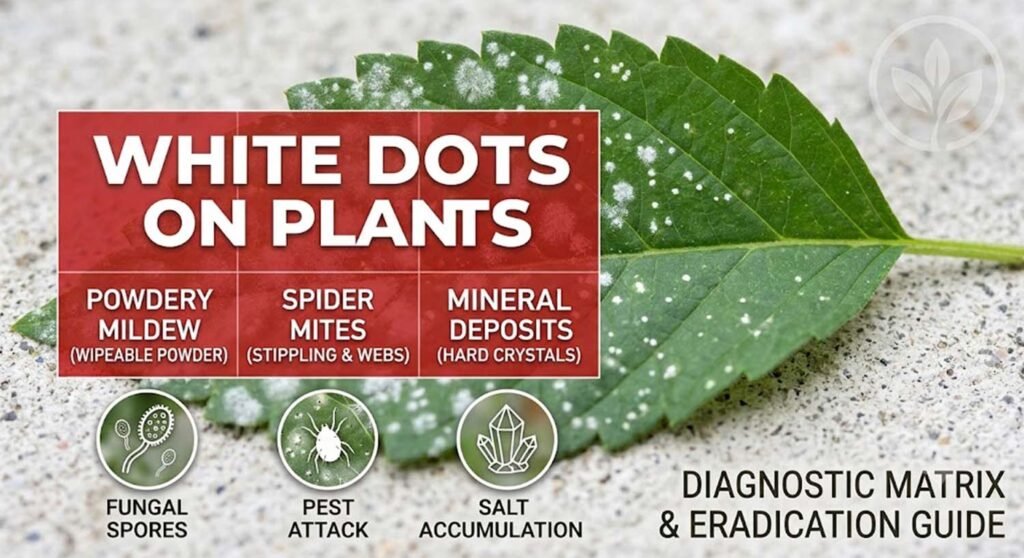
Introduction: The Heart-Stop Moment for Every Commercial Grower
Every commercial cultivator knows the routine. You walk into your facility in the early morning, ready to check the overnight canopy expansion. You bend down to inspect a fan leaf, and your heart instantly drops. There they are: tiny, mysterious white dots scattered across the once-vibrant green canopy.
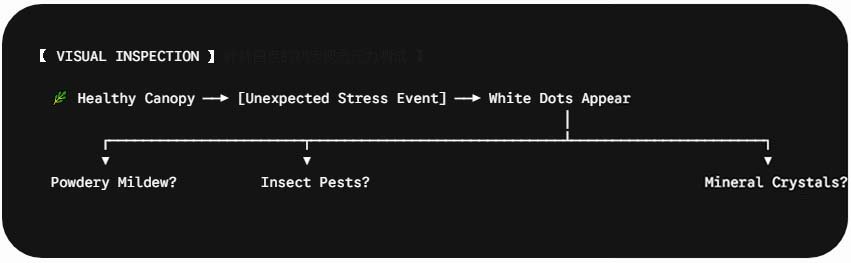
In the high-stakes world of facility agriculture, a white dot is never just a dot. It is a blinking red warning light from your plant’s biological engine. Depending on what is causing it, those white specks could mean your facility is hours away from a catastrophic Powdery Mildew outbreak, facing an invisible army of sap-sucking pests, or simply venting off excess nutrients.
If you diagnose it correctly within the first 48 hours, you protect your crop weight, secure your terpenes, and keep your harvest revenue entirely intact. If you ignore it, or worse, treat it with the wrong chemical protocol, you risk burning your canopy and rendering your entire multi-week investment completely unsellable.
Let’s skip the amateur gardening gossip. In this guide, we are going to breakdown the exact scientific diagnostic matrix to identify exactly what those white dots are, how to eradicate them, and how premium industrial-grade LED engineering stops these biological threats from setting foot in your facility ever again.
Identifying the 4 Root Causes of White Dots
To save your canopy, you must immediately separate biological enemies from normal physiological output. Before grabbing any chemical spray or adjusting your nutrient tanks, use this professional diagnostic matrix to match the exact visual texture and behavior of the white dots under a pocket microscope.
🚨 Facility Warning Line: "Never treat a white spot blindly. Mistaking Powdery Mildew for mineral crystals leads to catastrophic mold spreading, while applying harsh fungicides to a minor spider mite infestation allows pests to breed completely unchecked under your canopy."
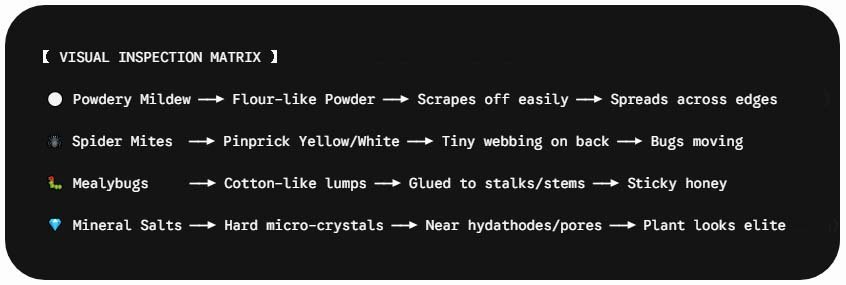
Powdery Mildew (PM): The Air-Borne Fungal Plague
- The Visual Diagnosis: These dots start as isolated, soft white specks that look exactly like someone accidentally spilled baking flour or powdered sugar on the leaves. As it progresses, these dots merge into large, fuzzy white patches that can completely carpet the upper surface of your fan leaves.
- The Touch Test: If you gently rub the white spot with your finger or a damp cloth, it wipes away effortlessly, leaving a dull, slightly yellowish patch underneath.
- The Biological Danger: 🔴 HIGH. PM is an aggressive fungal parasite (Podosphaera or Erysiphe). It thrives in facilities with high humidity (RH > 65%) and stagnant, dead-air zones. Once these white spores become visible to your naked eye, millions of invisible fungal chains are already floating through your HVAC system, ready to coat your entire crop and choke out photosynthesis.
Spider Mites: The Silent Sap-Sucking Army
- The Visual Diagnosis: These are not fluffy or powdery. They appear as thousands of microscopic, pinprick-sized white or pale-yellow pale stipples scattered across the top of the leaf. They look like the leaf has been stabbed a million times by a tiny needle.
- The Touch Test: You cannot wipe these dots away because they are not on top of the leaf - they are actual physical scars where the cells have been permanently destroyed. If you flip the leaf over and look at the underside, you will see microscopic silk webbing and tiny dots (yellow, white, or red) slowly crawling around.
- The Biological Danger: 🔴🔴 CRITICAL. Spider mites (Tetranychidae) are the ultimate crop vampires. They punch holes into the plant cells to suck out chlorophyll. In warm, dry commercial rooms, their life cycle speeds up drastically, allowing a single pair to explode into millions within 14 days, turning your high-end canopy into a dead, brown wasteland covered in thick webs.
Mealybugs & Scale: The Sticky Wax-Shielded Parasites
- The Visual Diagnosis: These look like small, distinct, individual wet cotton balls or white oval shields nestled tightly in the knuckles where the leaf stem meets the main branch. They rarely sit out in the open on the leaf flat; they prefer to hide in dark, tight physical crevices.
- The Touch Test: If you poke them with a toothpick, they feel mushy and waxy. They do not wipe away like powder; instead, they leave a sticky, sap-like residue on the plant stem.
- The Biological Danger: 🟡 MEDIUM-HIGH. Mealybugs use a protective powdery wax coating as a shield against standard contact pesticides. They drain plant energy and excrete a sticky, sugary fluid called "honeydew." This fluid sits on your canopy and acts as the perfect breeding ground for Black Sooty Mold, which permanently ruins crop.
Mineral Salt Deposits: The Completely Harmless Flushed Out Crystals
- The Visual Diagnosis: These are bright, stark-white, hard micro-crystals that appear primarily at the absolute tips and edges of the leaves, or directly surrounding the tiny pores (hydathodes). The dots look like clean, sharp sea salt grains under a lens.
- The Touch Test: They feel grainy and sand-like to the touch. If you lick your finger and rub them, they dissolve instantly and vanish completely because they are water-soluble nutrients.
- The Biological Danger: 🟢 SAFE. This is not a disease or a pest. This is a purely natural physiological process called guttation. When you run a heavy nutrient recipe (High EC) and high root pressure overnight, the plant pumps out excess water containing dissolved fertilizers through its edge-pores. When the water evaporates under your morning grow lights, the pure mineral salt crystals are left behind. It simply means your crop is fed to maximum capacity and you should slightly back down your feeding chart.
How to Eradicate and Treat "White Spots on Leaves"
Once you have used our diagnostic matrix to determine why your plant leaves have white spots, you must deploy an immediate, targeted eradication protocol. The faster you eliminate the root cause, the faster your canopy returns to driving maximum yield. Here is the professional, step-by-step treatment protocol for each specific threat to a plant with white spots on green leaves:
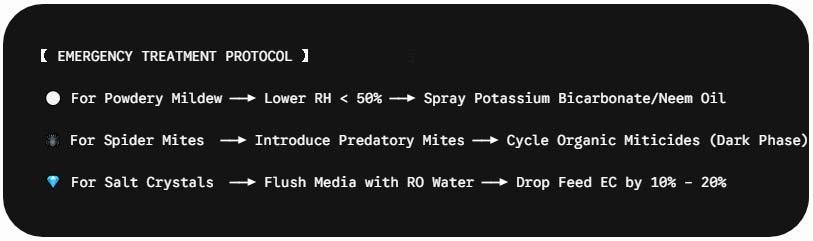
Eradicating Powdery Mildew: Breaking the Fungal Lifecycle
If your white spot plant diagnostic shows a flour-like powder that rubs off easily, you are dealing with an active fungal attack. You must immediately change the micro-climate and apply an organic knockout spray.
- Step 1: Environmental Shock Therapy. Fungal spores thrive in stagnant, humid air. Immediately drop your facility's Relative Humidity (RH) below 50%. Increase your oscillating fan speed to eliminate all dead-air zones within the lower and middle canopy layers.
- Step 2: Organic Knockout Spray. Mix a solution of Potassium Bicarbonate (3 to 5g per liter of pure water) or premium organic Neem Oil with an emulsifier. Spray the entire canopy thoroughly during the dark cycle or at the lowest light dimming stage to avoid leaf burn. Potassium bicarbonate dramatically shifts the pH on the leaf surface, instantly collapsing the fungal cell walls on contact.
- Step 3: Quarantine and Pruning. Carefully cut away and bag the heavily infected fan leaves showing large white patches. Do this gently so you do not send millions of invisible spores flying through your ventilation grid.
Hunting Spider Mites: Eliminating the Sap-Sucking Invasion
When you see a plant with white spots on green leaves that look like tiny pinpricks, the clock is ticking. Because these mites lay hundreds of eggs a day, you must run a multi-day eradication cycle.
- Step 1: Biological Warfare (Predatory Mites). In commercial facilities where you want to keep your final harvest 100% chemical-free, introducing beneficial insects like Phytoseiulus persimilis is the ultimate move. These predatory mites do not eat plants; instead, they move like heat-seeking missiles across your canopy, devouring thousands of spider mite eggs and adults per day.
- Step 2: The Organic Suffocation Protocol. If the infestation is already severe, use an organic, oil-based insecticidal soap or horticultural oil during the plant's sleep cycle. Spray the underside of the leaves with extreme pressure. These organic sprays work by physically coating the mite's body, suffocating them instantly without leaving toxic chemical residues on your premium final yield.
- Step 3: The 3-Day Knockout Rule. Mite eggs hatch every 3 days in warm rooms. You cannot just spray once and walk away. You must treat the canopy three separate times over a 9-day period to kill the newly hatched generations before they reach reproductive maturity.
Resolving Mineral Salt Deposits: Flushing Your Substrate
If you find a white dot on plants that turns out to be hard, grainy mineral crystals locked tightly around the leaf edges, your plants are completely healthy, but their diet is too heavy. They are screaming that they are over-fertilized.
- Step 1: The Media Flush. Stop feeding heavy nutrient formulas immediately. For the next 1 to 2 irrigation cycles, run pure, pH-balanced RO (Reverse Osmosis) water through your coco, soil, or rockwool substrate. Aim for a generous 20% - 30% runoff at the bottom of the pots to dissolve and wash away the compacted fertilizer salts clogging the root zone.
- Step 2: Recalibrate the Feeding Chart. Check the Electrical Conductivity (EC) of your drainage runoff. If the runoff EC is significantly higher than your input nutrient EC, drop your incoming fertilizer strength by 10% - 20% for the upcoming week. This clears up the white spots on leaves instantly as the plant re-balances its internal osmotic pressure and stops sweating out excess salts.
How Premium LED Engineering Prevents "White Spots" Before They Start
When your plant with white spots on green leaves is suffering, treating the symptoms with chemical sprays and manual flushes is a reactive battle. In a large-scale commercial operation, reacting means losing time and money. The most successful facilities do not just treat white spots on leaves - they design an environment where biological threats cannot survive.
By deploying an industrial-grade, multi-channel led grow light fixture with a scientifically tailored spectrum, you build a 24-hour botanical shield that eradicates mold spores and armors your crops against insect invasions.
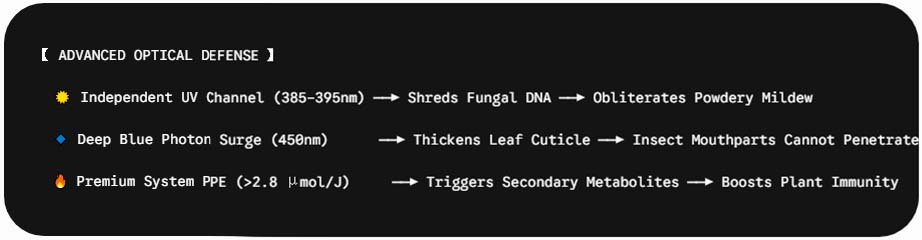
Independent UV Channels (395nm): The Ultimate Anti-Fungal Nuclear Weapon
If your white spot plant diagnostic keeps pointing toward Powdery Mildew, your facility has a microscopic mold problem floating in the air. While copper-based sprays can damage your flowers, ultraviolet light delivers a clean, zero-residue physical solution.
- The Science: Microscopic mold spores and fungal hyphae have incredibly fragile outer membranes. Photons in the UV bands punch right through these cell walls and directly scramble the nucleic acid and DNA chains of the fungal organism. The fungus loses its ability to replicate and shrivels into dust.
- The Power of Separation: Because some of our grow light models feature an independent UV circuit and switch, you don't have to stress the plants by running radiation all day. By flipping the UV channel on for just 2 - 4 hours a day during the flower cycle, you create a sterile leaf surface where a white spot plant outbreak is physically impossible, all without altering early vegetative cell expansion.
Deep Blue Surge (450nm): Forging a Physical Shield Against Sap-Sucking Pests
When insects like spider mites and mealybugs attack a plant, they are looking for soft, weak, bloated green tissue where their sharp mouthparts can easily pierce the cell walls to drain chlorophyll. A generic "blurple" or low-quality white light creates exactly that - stretched out, soft leaves.
- The Blue Light Armor: Our high-performance commercial spectrum infuses a dedicated surge of 450nm Deep Blue photons. When a plant detects heavy blue light, it halts vertical stretching and triggers photomorphogenic structural hardening.
- The Result: The leaf epidermic cells pack together with extreme density, and the outer waxy cuticle layer becomes significantly thicker and tougher. When spider mites or scales land on a crop raised under this premium spectrum, their tiny mouthparts literally cannot punch through the toughened plant skin. They cannot feed, they cannot replicate, and your plant with white spots on green leaves scenario is stopped before the first pest can even take a bite.
Premium High PPE (>2.8 μmol/J): Weaponizing the Plant's Internal Immune Engine
The absolute best pesticide or fungicide on Earth does not come in a plastic bottle from a chemical company - it is synthesized naturally inside the plant itself.
- The Secondary Metabolite Trigger: When you blast a crop with an authentic, high-end led grow light fixture operating at a premium efficiency exceeding 2.8 to 3.1 μmol/J, you saturate the plant's photosynthetic engine with maximum useable light energy.
- Natural Chemical Defense: The crop doesn't just use this massive energy pool to build fiber and sugar; it channels the surplus energy into its secondary metabolic immune pathways. The plants begin to flood their own tissues with bitter terpenes, defense-oriented enzymes, and natural pest-repellent phytoalexins. When an aggressive fungus or sap-sucking insect tries to take hold, the plant’s own internal chemical warfare engine kills the pathogen on contact. Your white spot plant anxieties disappear, replaced by thick, frosting, cash-crop colas that run entirely trouble-free.
Conclusion
Finding a white spot on plants or noticing that your plant leaves have white spots is a critical turning point for any commercial cultivation facility. It is not a sign of failure - it is a clear, real-time diagnostic evaluation of your current micro-climate and lighting infrastructure. You can choose to stay trapped in a reactive loop—spending thousands of dollars every quarter on toxic chemical sprays, losing labor hours to manual leaf scrubbing, and watching your final weight and terpene profiles degrade under outdated, low PPE lighting. Or, you can choose to build an unbreachable physical defense line. Hoping this article can help you make decisions and get good results.
FAQ (Uncommon Causes "White Spot" Across Popular Cultivars)
Q1: What causes white spots on plant leaves and how can I fix it when transitioning from indoors to greenhouse setups?
- A: If it's during environmental shifts, the answer is usually Sunscald (Light Shock) or localized micro-climate failure. If you move tender indoor crops out to a commercial greenhouse without hardening them off, the sudden unfiltered solar radiation can literally bleach the chlorophyll in patches, creating stark white lesions. Alternatively, if your ventilation drops, an explosive outbreak of Powdery Mildew will appear overnight. The Fix: Transition crops gradually using temporary shade clothes (30% - 50% block). If the dots are fungal, activate your grow lights' independent UV channel to sanitize the air, and spray potassium bicarbonate immediately.
Q2: I am seeing white spots in tomatoes, specifically white spots on tomato seedling leaves and stems. Is this a pest or a disease?
- A: If you notice white spots in tomatoes, the diagnosis depends heavily on the growth stage and exact location of the spots.
- Case A: White spots on tomato seedling leaves. If the dots appear on young seedlings right after a cold night or a heavy watering cycle, it is often Edema. The roots took in more water than the leaves could transpire, causing the plant cells to swell and burst, leaving tiny white or tan crusty scars. Another major threat is Septoria Leaf Spot, a fungal disease that creates circular white/grey spots with dark borders.
- Case B: White spots on tomato stem. If the white spots on tomato stem are actually hard, tiny bumps near the base of the plant, don't panic. These are adventitious root initials (primordia). Tomatoes naturally try to grow more roots from their stems if humidity is high or if they need more structural support. However, if the spots are fuzzy or powdery, it is Powdery Mildew, meaning your tomato leaves have white spots that will soon choke out the lower canopy.
When tomatoes have white spots on leaves, immediately check your facility's root-zone temperature and humidity. You also can upgrade to a high-PPE LED spectrum with enhanced blue light to harden the tissue of white spots on tomato plants leaves, transforming weak seedlings into robust, woody-stemmed plants.
Q3: Why does my plant have white spots on the leaves in an outdoor commercial field versus an indoor room?
- A: The macro-environment dictates the enemy biological profile. When diagnostics show a white spots on plant leaves outdoor scenario, the culprit is often completely different from controlled indoor rooms.
- Outdoor Cultivation: Outdoor crops are exposed to wild insect vectors. The primary cause of a why does my plant have white spots on the leaves inquiry under the sun is usually Thrips, Leafhoppers, or Flea Beetles. These insects chew or rasp away the top layer of the green leaf leaf, leaving behind bleached, silvery-white windows.
- Indoor Controlled Environment Agriculture (CEA): Indoors, you rarely get flea beetles. Instead, the white dots are almost exclusively Spider Mites (due to static micro-climates) or Powdery Mildew (due to poor HVAC airflow configuration under intense crop transpiration).
Q4: I specialize in high-value horticulture. What does a cannabis white spots outbreak typically mean, and how do I prevent it?
- A: In premium licensing facilities, cannabis white spots are the ultimate revenue killer. A single bad batch showing white spots on cannabis will fail laboratory micro-biological compliance tests, forcing you to destroy the entire harvest.
The Dual Threat:
- Powdery Mildew (PM): This is the #1 threat. Cannabis has dense, overlapping canopy structures that trap moisture. PM starts as faint white dots and quickly consumes the resinous flower heads, turning top-shelf colas into a toxic, unsellable mold risk.
- Two-Spotted Spider Mites: They pierce the fan leaves, leaving a starry-night pattern of pale white dots, dragging down the plant's photosynthetic power and reducing essential oil production.
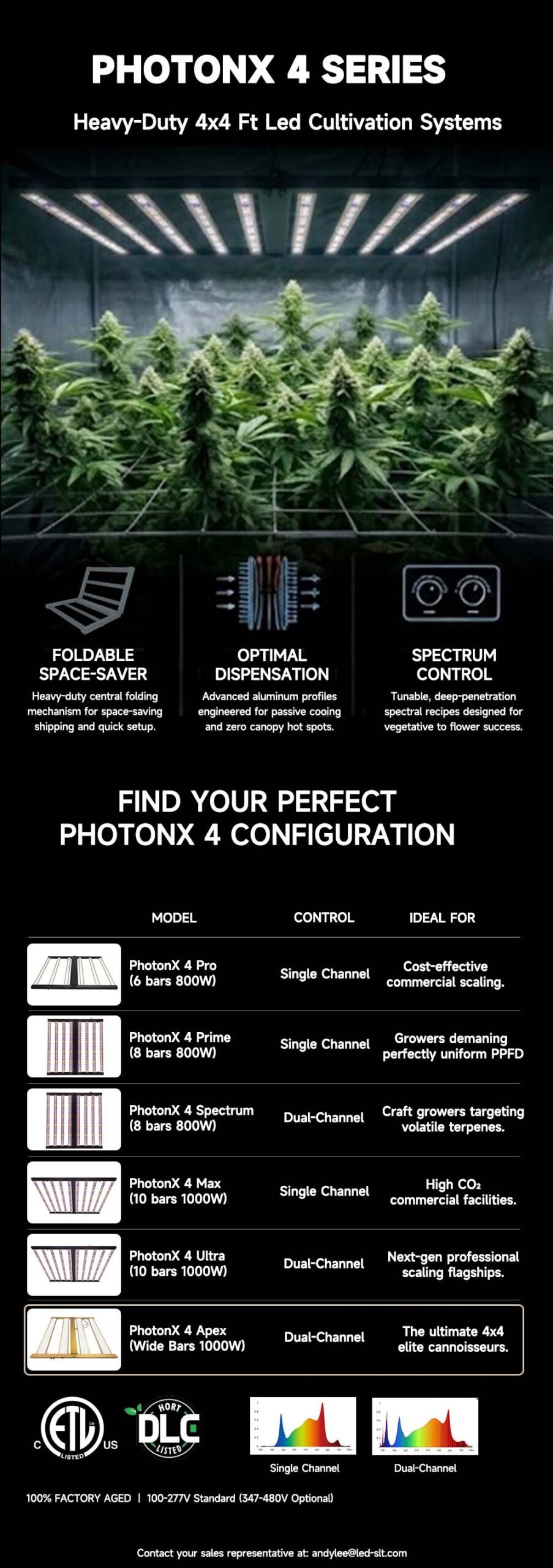
The Solution: Never spray heavy chemicals during the late bloom phase. Instead, commercial facilities mount our advanced PhotonX 4 series grow light systems equipped with an integrated independent UV control channel. Running this channel targets the DNA of the fungi floating near the buds, keeping the crop entirely cannabis white spots free and completely organic, guaranteeing a passed lab certificate every single harvest.
Q5: My indoor Aroids (Monstera, Alocasia, Pothos) have tiny, silvery-white spots. Is this powdery mildew?
- A: These are almost never powdery mildew. Instead, this is the classic visual signature of a Thrips (Thysanoptera) infestation. Thrips have "punch-and-suck" mouthparts. They rasp open the top layer of the leaf tissue and literally suck out the cellular contents. Because they empty the plant cells of chlorophyll, air enters the empty cell casings, creating a distinct shimmering, silvery-white stippling effect on the green leaves. Unlike powdery mildew, you cannot wipe this off, and you will often see tiny, black tar-like dots of insect excrement right next to the white spots. The Fix: Thrips are notoriously resistant to basic sprays. You must deploy biological warfare immediately by releasing predatory mites like Amblyseius swirskii or applying systemic organic treatments like Spinosad during the dark cycle.
Q6: My Cucumbers and Zucchinis are covered in large, blocky white spots, but it doesn't look like flour. What is this?
- A: For cucurbits (cucumbers, melons, squashes), white spots can be an early warning sign of Downy Mildew (Pseudoperonospora cubensis) or severe environmental leaf bleaching. While Powdery Mildew blankets the leaf indiscriminately in a round, powdery fashion, Downy Mildew is highly geometric. It produces angular, blocky white or pale-yellow spots that are strictly confined by the leaf's natural veins. It looks like a mosaic checkerboard. On the flip side, if these blocky spots appear overnight after an indoor grow light upgrade, it is likely light bleaching - the high PPFD output has overwhelmed the plant's pigment matrix, destroying the chlorophyll without any fungal infection present. The Fix: If it's Downy Mildew, immediately drop humidity and apply an organic copper fungicide. If it's light bleaching, utilize the master dimming controller on your grow light lamp to drop the intensity to 60% - 70%, allowing the plant to acclimate to the premium photon density before cranking it back up to full power.
Q7: My Succulents and Cacti have hard, white, chalky dots. Are they dying?
- A: Succulents have completely different evolutionary adaptations than leafy crops. White dots on these desert varieties are usually Calcium Deposits or a protective layer called Epicuticular Wax (Farina). Many succulents are watered with hard tap water rich in calcium and magnesium. Through a process similar to guttation, the plant expels excess calcium through its specialized pores, leaving behind tiny, rock-hard, chalky white dots that look like a disease but are 100% inert. Alternatively, if the "white spots" look like a smooth, hazy white film across the whole plant, do not scratch it off! This is Farina—a natural, wax-like sunscreen engineered by the plant to shield its flesh from UV damage and prevent water loss. The Fix: Switch from hard tap water to pure RO (Reverse Osmosis) water for future water cycles. The mineral dots will stop forming, and the plant will naturally outgrow the existing spots. Never wipe or scrub a succulent's hazy white coating, as it protects the plant under intensive grow lights.
Q8: My Strawberry plants have tiny white dots on the green leaves, and the fruit stems look dusty. How does this affect my commercial yield?
- A: In commercial indoor strawberry vertical farms, white dots are an absolute emergency code for Strawberry Powdery Mildew (Podosphaera aphanis). Strawberries are highly susceptible to high-humidity true fungal attacks. The white dots start discreetly on the undersides of the green leaves, causing the edges to curl upward like a teacup. If not arrested within 72 hours, the powdery white chains spread rapidly to the stolons, fruit stems, and the strawberries themselves, turning a premium sweet berry into a fuzzy, tasteless, unmarketable waste product. The Fix: You can try our multi-channel led grow light lights. Traditional chemical fungicides alter the brix (sugar content) and taste profile of strawberries, ruining consumer premium pricing. Commercial vertical farms deploy our multi-bar LED fixtures with an integrated, automated daily UV pulse. By giving the canopy a precise dosage of UV photons every night, you stop the strawberry mildew from germinating on the leaf surface, ensuring a pristine, chemical-free, high-brix crop that fetches top dollar in the retail market.
Q9: Why are my lower green leaves getting white spots right after I turned on the automated CO₂ injection system?
- A: This is a classic symptom of Accelerated Transpiration Stress (Nutrient Precipitation) caused by rapid metabolic mismatch. When you suddenly inject industrial levels of CO₂ (raising levels to 1200 - 1500 ppm) under high-output grow lights, the plant's metabolic engine goes into overdrive. Photosynthesis skyrockets, and the root system starts pumping water and liquid nutrients upward at an unprecedented speed to keep up with the leaf demand. However, if your room's airflow isn't perfectly uniform, the stagnant air around the lower leaves creates a pocket of high relative humidity (RH). The lower leaves can't transpire fast enough to release the massive volume of water being pushed up from the roots, causing the minerals (calcium and salts) to crash out of solution inside the leaf tissue, leaving micro-deposits of dead, calcified white cell clusters. The Fix: Never run high CO₂ without perfectly balanced air movement. When upgrading to high-CO₂ protocols, increase the speed of your lower canopy oscillating fans to strip away the stagnant boundary layer of air, keeping the transpiration stream moving smoothly.
Q10: Can commercial cleaning chemicals or ozone generators leave white spots on my canopy?
- A: Yes. This is known as Chemical Phytotoxicity (Oxidative Bleaching), and it is a massive hidden risk in hyper-sterile facility management. Ozone Shocks: Many high-tech facilities run commercial ozone (O₃) generators during the dark cycle to sterilize the air against mold spores. However, if the ozone levels leak above safe thresholds or fail to dissipate before the lights turn on, the intense oxidative power of the gas will literally burn the leaf epidermis, causing thousands of random, bleached white micro-dots across the upper canopy. Chemical Overspray: If your crew sanitizes the multi-tier racks or walkways using hydrogen peroxide, bleach, or peracetic acid solutions while crops are present, the airborne drift and micro-mist can land on the green leaves. Within hours, these acidic or alkaline droplets bleach out the chlorophyll, creating permanent, chemical white burn spots. The Plant Factory Rule: Always turn off ozone equipment at least 2 hours before the light cycle begins to allow the O₃ to safely decay back into stable O₂. When deep-cleaning walls and racks with sterile chemicals, use low-pressure coarse sprays instead of ultra-fine mists to prevent chemical drift from landing on your high-value canopy.