
Introduction: The Brand Premium vs. The Reality of the Grid
When a commercial cultivation facility scales up, lighting infrastructure is the heaviest capital expenditure (CapEx) item on the spreadsheet. For years, major tier-1 brands like Philips (Signify) and Gavita have commanded a premium 2 to 3 times higher than factory-direct alternatives. Under intense market competition, master growers and CFOs can no longer afford to buy a luxury logo. They must calculate a brutal, real-time question: Will this massive upfront investment lower my monthly power bill (OpEx) fast enough to justify its cost?
Let's be clear: Philips and Gavita build world-class hardware. Their optical engineering has defined industry standards. However, in 2026, the global optoelectronic supply chain has completely democratized ultra-high bin LED chips and driver technologies. A photon emitted at a target wavelength by a top-tier diode is biologically identical, whether it sits behind a premium European brand logo or comes straight from a leading-edge source factory's assembly floor.
This technical whitepaper strips away the multi-million dollar marketing campaigns to deconstruct the raw physics of Photosynthetic Photon Efficacy (PPE), spatial uniformity, and structural limitations. We will analyze why traditional toplighting architectures fall short in tight spaces, and how direct-factory innovations - such as our modular series and the high-power Golden 1300W Foldable Bar - deliver unmatched yield-per-watt without the brand tax.
The Metric of Truth: Photonic Efficacy (PPE) vs. Form Factor Flaws
When buying commercial LED grow lights, judging a fixture's efficiency by looking at its wattage (Watts) is the fastest way to lose money. Wattage only tells you one thing: how much the electric company is going to charge you. It tells you absolutely nothing about how much usable light actually reaches your plants.
In the professional growing world, the only metric that matters for efficiency is PPE (Photosynthetic Photon Efficacy), measured in μmol/J. In plain English, PPE represents a simple math equation: For every single dollar of electricity you put into the light, how many actual, usable "light particles" (photons) does it spit out? The higher the PPE number, the more efficient the light is at turning raw electricity into plant-growing power.

The Form Factor Trap: Don't Buy High Stats on a Uneven Design
Here is the catch that most growers miss: High laboratory efficiency does not guarantee a lower power bill or a bigger harvest. This is what we call "The Form Factor Trap". An elite, luxury brand can proudly brag that their light has a massive PPE rating of 3.5 μmol/J}. But if that light is built into a heavy, rigid, old-school box with narrow lenses, those premium light particles are forced into a tight, laser-like beam. When you hang that light over a real canopy, your expensive electricity gets wasted in two ways:
- Bleeding Light Onto Walls and Floors: Because the light is shot from high up in a tight cone, a huge chunk of the photons miss the plants entirely. They hit the concrete walkways, bounce off the plastic walls, or escape right through the greenhouse glass. A photon that hits the concrete floor does zero work for your crop. Its efficiency is effectively reduced to zero.
- Fried Leaf Centers and Dark Corners: Directly under this single-point powerhouse, the light intensity is so blindingly high that it creates a hotspot. Plants have a limit to how much light they can take; past that point, the extra light is wasted as heat or actually bleaches and damages the leaves. Meanwhile, just a couple of feet away at the edges, the plants are starving in the dark because the light drops off a cliff.
In 2026, real energy efficiency isn't about what a brand prints on its shiny brochure. Real efficiency is "Canopy Delivered Efficiency" - what percentage of your electric bill actually turns into evenly-spread photons that your plants can actively eat. In the next sections, we will open up the real commercial grow layouts to show you the traditional toplighting formats and engineering alternatives give you more usable photons per dollar.
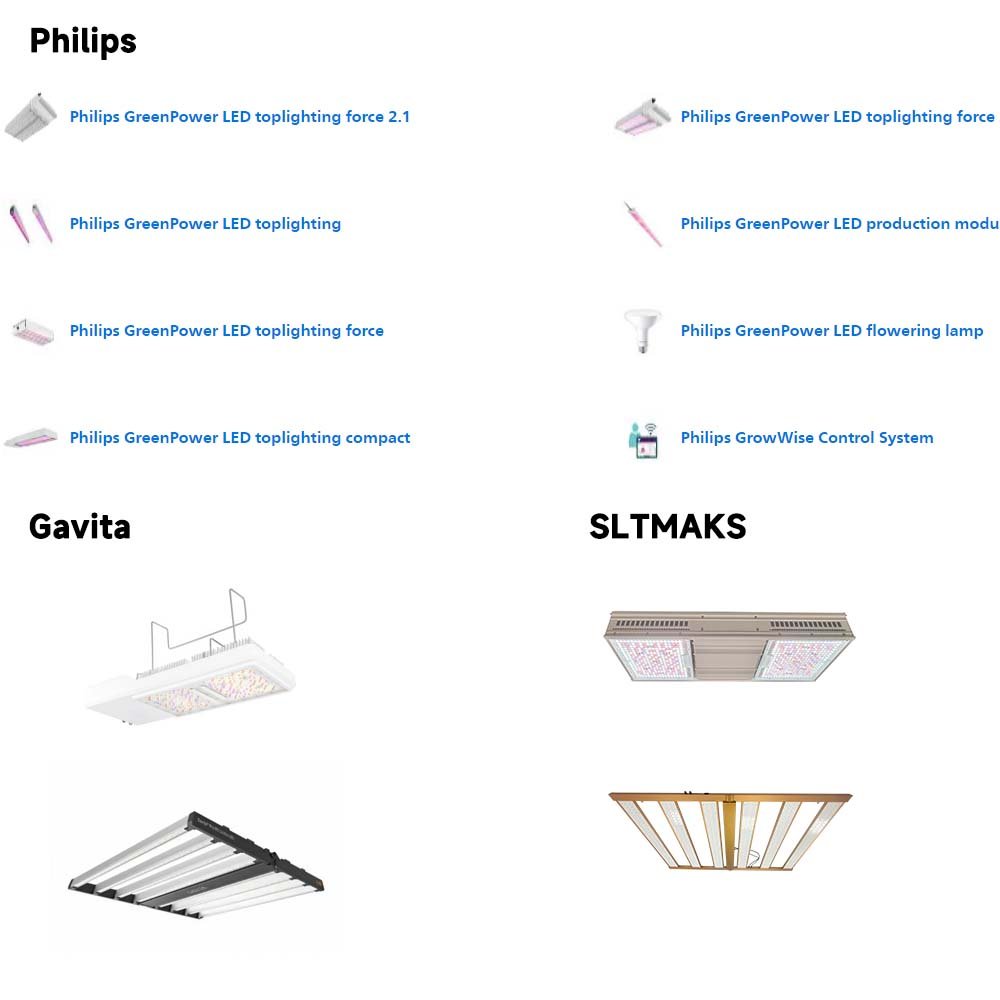
The High-Ceiling Toplighting Arena - Philips GreenPower Led Toplighting & Gavita 1930e vs. Our 800W Led Grow Light Module
In commercial cultivation, facility height dictates your lighting strategy. For large-scale greenhouses and traditional high-clearance facilities, Toplighting remains the standard architecture. In this specific high-ceiling arena, the industry giant Philips and the North American heavyweight Gavita with their 1930e deploy their flagship weapons. However, this is also where our re-engineered Module Series delivers a much smarter, more uniform financial path for the exact same environment.
Philips Linear, Gavita 1930e, and our Module Series are engineered strictly for high-ceiling environments. These fixtures rely on physical distance to allow their photon streams to mix. Trying to force any of these high-elevation toplights into height-restricted modern indoor rooms or tight multi-tier vertical farming racks is a catastrophic operational mistake that will bleach leaves and ruin crops.
Philips & Gavita 1930e Led Modules
- The Philips Profile: The Philips GreenPower Toplighting series achieves an impressive laboratory efficiency of 3.3 - 3.7 μmol/J. However, its housing is rigid and unidirectional. It fires a concentrated beam of photons straight down in a sharp, narrow cone. To get an even canopy coverage from the rafters, you are forced to buy an excessive number of units to create overlapping grids, causing your initial CapEx to explode.
- The Gavita 1930e Profile: The Gavita 1930e operates at a much lower efficiency tier, dragging at a legacy 2.5 μmol/J. Why? Because it was built with a retrofitted compromise mindset - designed purely to match the exact single-point compact footprint of ancient 1000W High-Pressure Sodium (HPS) lights. It shoots an intense, hot spotlight from a single center point, leading to rapid edge-collapse where the light intensity drops off a cliff just a few feet away from the center.
SLTMAKS 800W LED Module: The Double-Sided Efficacy Breakthrough
- Lamp Efficacy 3.0 μmol/J: We don't play with fake numbers. Our toplightng module delivers a rock-solid, real-world system efficiency of 3.0 μmol/J. It completely leaves the Gavita 1930e 2.5 μmol/J in the dust, and stands toe-to-toe with the actual operational output of Philips, ensuring that every watt drawn from your electric grid is weaponized into growing power.
- The Double-Sided Innovation: This is where we break the big-brand design flaw. While Philips and the 1930e use a traditional single-sided downward push, our 800w led grow light features a revolutionary Double-Sided Light Emission design. By splitting and angling the optical arrays to fire from two faces, the light doesn't just shoot dead-straight down; it throws a massive, cross-firing horizontal net of light.
- Absolute Cross-Canopy Uniformity: When hung high in the rafters, this double-sided glow allows the photon footprints to seamlessly blend in mid-air long before they hit the crops. It completely eliminates the aggressive center hotspots of the 1930e and the harsh dark gaps left between Philips rows. You get a perfectly flat, uniform blanket of high-density PPFD across your entire crop surface.
- The Factory-Direct Pricing Victory: By cutting out the bloated corporate overhead, multi-million dollar marketing funds, and greedy third-party distributors that balloon the cost of Philips and Gavita, we deliver this advanced double-sided engineering at direct-from-factory cost. We slash your upfront hardware investment by over 50%, giving you better uniformity, higher average light intensity, and massive cash savings from day one.
The Indoor & Vertical Arena - Why Toplighting Fails and The Bar-Style Evolution
When evaluating energy efficiency, you cannot look at a light fixture in a vacuum. You must look at the room it hangs in. For large, ultra-high ceiling commercial glass greenhouses, traditional Toplighting (like Philips Linear or Gavita 1930e) works because the lights have 15 to 20 feet of clearance to let their narrow beams mix in the air. However, if you are running a modern Indoor Grow Room or a Multi-Tier Vertical Farm, forcing a Toplighting fixture into that tight space is a catastrophic operational mistake.

The Low-Clearance Death Trap for Toplighting
Inside an indoor facility or vertical rack, you don't have 15 feet of hanging height. You often have less than 3 to 5 feet of space between the light and the plant canopy. When you hang a Philips Linear or a Gavita 1930e toplight this close, their legacy narrow optics create two massive efficiency failures:
- Canopy Scorching: The light doesn't have room to spread out. It shoots straight down like a laser, creating a severe hotspot directly under the bar. This hyper-concentrated light over-saturates the crop, bleaching leaves and stalling plant growth.
- The Dead Perimeter: Just two feet away from that center hotspot, the light levels drop off a cliff. The perimeter plants are left starving in the dark, destroying your harvest consistency.
- The "Air Waste" Reality: In a tight indoor room, any photon that bounces off the concrete floor or blasts into a plastic wall is pure wasted money. A light that is 3.5 μmol/J in a laboratory brochure is functionally reduced to zero when its shape forces it to waste light in empty walkways.
The Form Factor Evolution: Direct-Factory Bar Style Architecture
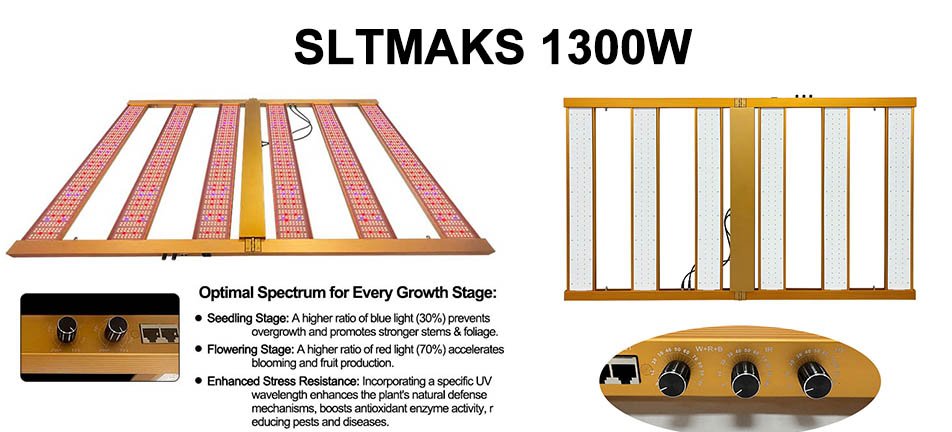
To win in Indoor and Vertical environments, you must abandon the single-point toplight and adopt the Multi-Bar Folding Form Factor. By controlling the entire semiconductor and mechanical supply chain from the ground up, our premier source factory engineered the ultimate answer to this spatial crisis: Our Golden 1300W Heavy-Duty Foldable Bar.
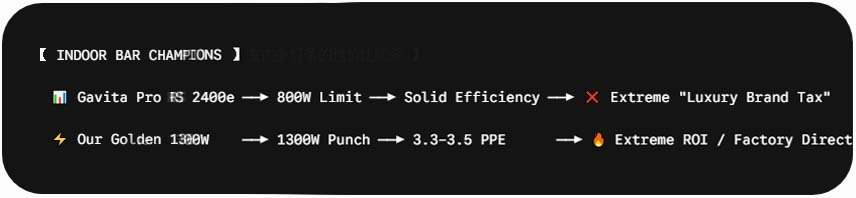
- The Gavita 2400e Reality Checklist: To compete in the indoor bar-style market, big brands try to offer options like the Gavita Pro RS 2400e (V2). The 2400e is an 8-bar foldable fixture running at 800W with a decent efficiency of 3.2 μmol/J. It successfully smooths out the hotspots, but it carries a crushing "North American Brand Tax." It is sold at an inflated luxury price tag that severely delays a commercial facility's path to positive cash flow.
- Our Golden 1300W - Breaking the Efficiency Ceiling (3.3 - 3.5 μmol/J: Why settle for an expensive 800W light when you can have a direct-factory powerhouse? The Golden 1300W runs on a hyper-efficient drive platform that pushes its system PPE to a breathtaking, proved 3.3 - 3.5 μmol/J. It instantly leaves the Gavita 2400e 3.2 μmol/J behind, delivering the absolute absolute highest limits of photon efficiency directly to the plant's mouth.
- The "Cloud Matrix" Distribution: Instead of shooting light from a single distant line, the Golden 1300W spreads its massive photon output across a wide, multi-bar grid. It transforms the light source into an overhead "cloud matrix." This allows you to drop the light mere inches above the plant canopy in tight indoor rooms or vertical setups. It delivers incredibly intense, high-density PPFD across every square inch of your crop with zero hot-spots and absolute, flawless uniformity.
- 1-for-Multiple Economic Victory: One single Golden 1300W fixture outputs a volume of usable photons that can easily replace up to 2 expensive brand-name toplights or completely overpower the 800W Gavita 2400e. By replacing multiple small lights with one heavy-duty 1300W bar, you eliminate 75% of your ceiling mounting drop-points, slash your electrical installation labor hours, and throw away the heavy, power-wasting transformer nests. You stop buying expensive big-brand aluminum badges, and start routing every single watt of electricity directly into raw crop weight.
The Master Comparison: Philips vs. Gavita vs. SLTMAKS
When managing the financial scaling of a commercial cultivation facility, data must always override brand emotion. Below is the raw engineering and economic reality of the industry’s leading fixtures plotted head-to-head.
| Key Metrics | Philips Green Power Toplighting | Gavita CT 1930e | SLTMAKS Toplighting | Gavita 2400e | SLTMAKS Golden 1300W |
| Form Factory | Toplighting | Compact Toplight | Toplighting | 8-Bar Foldable | 6 Wide-bar Foldable |
| PPE | 3.3-3.7μmol/J | 2.47μmol/J | 3.0μmol/J | 3.2μmol/J | 3.3-3.5μmol/J |
| Dimensions | 27.2"×12.2"×4.4" | 29"×11.8"×3.9" | 27.6"×12.4"×4.4" | 43.3"×44.8"×3.3" | 70.5"×43.3"×2.0" |
| Footprint | 4×4 ft | 5×5 ft | 6×6 ft | 5×5 ft | 6×8 ft |
| Dimmable | 10-100% Requires external system | 0-10V external central control only | 0-100%, Both knob dimmer and external supported | 0-10V external central control only | 0-100%,(Dual-Channel) Both knob dimmer and external supported |
| Power Factor | 0.98 | >0.95 | >0.98 | >0.95 | >0.98 |
| Price | $789 | $1088 | $328 | $1299 | $398 |
Objective Technical Guidance: Understanding Your Options
Form Factor & Footprint: Solving the Toplighting Limitation
Traditional toplights (Philips and Gavita 1930e) rely heavily on vertical distance. When hung too low in height-restricted indoor rooms, their narrow-angle design creates severe hotspots directly beneath the diodes, while leaving the perimeter under-lit.
In contrast, multi-bar bar-style architectures completely eliminate this footprint flaw. The Gavita RS 2400e does this well for standard setups, but our Golden 1300W takes it a step further with a massive 4×6 ft physics framework. This expansive physical dimension allows it to deliver a smooth, uniform cloud of photons that can comfortably cover a maximum footprint of up to 6×8 ft, minimizing the number of fixtures required per room.
Granular Dimming Flexibility: Local vs. Network Control
Operational efficiency requires flexible light intensity curves depending on the plant's growth stage (clones, vegetative, and flowering). Philips and Gavita fixtures are often stripped of local controls, requiring the permanent installation of external, proprietary master control systems.
Both our Module Series and Golden 1300W fixtures prioritize granular, dual-layer control:
- Local Granular Control: Each unit features an onboard, precision 0-100% continuous dimming knob for instant manual micro-adjustments directly on the bench.
- Network Daisy-Chaining: For commercial scaling, each fixture is built with standard RJ network ports, allowing thousands of units to be daisy-chained and automated via industry-standard external central controllers.
Photoperiod and Spectrum Optimization: Advanced Dual-Channel UV/IR
One of the most defining advancements in 2026 horticulture lighting is dynamic spectral steering. Standard industry fixtures offer a single, unchangeable, broad-spectrum channel. To address this, our Golden 1300W offers a dual-channel and three-channel upgrade option. This system allows growers to run a standard broad-spectrum channel for general growth, while maintaining independent, granular switch control over the integrated UV (Ultraviolet) and IR (Infrared) diode arrays. This enables you to deploy UV for quality enhancement and IR for photoperiod shade-avoidance acceleration exactly when the crop requires it, without wasting energy during phases where it is not needed.
Conclusion: Eliminating the "Brand Tax"
The commercial horticulture industry is undergoing a massive shift in 2026. For the past decade, corporate mega-brands have dominated the market simply because they were the early pioneers. But as the data clearly shows, LED technology has matured into a precise semiconductor science. There is no "magic" in a Philips or Gavita fixture - there are only diodes, drivers, heat sinks, and form factors.
When you buy from legacy brands, up to 50% of your invoice goes toward multi-tier distributor margins, international marketing budgets, and corporate overhead. You are paying a heavy "Brand Tax" that actively damages your facility's Return on Investment (ROI).