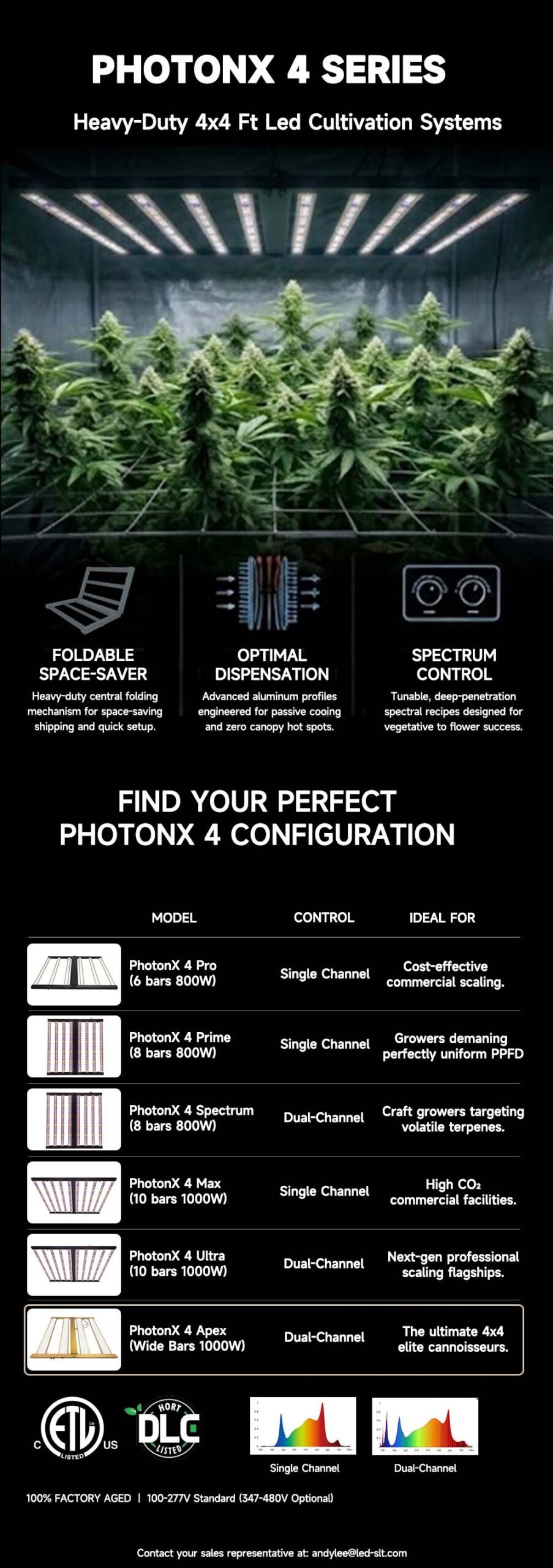
When you scale up to an 800-watt LED grow light, you are no longer just buying a plant accessory - you are deploying a serious piece of industrial facility infrastructure. At this high-output wattage tier, choosing the wrong fixture doesn't just mean a minor drop in crop weight. It directly triggers severe canopy bleaching, blown circuit breakers, thermal management failures, and massive spikes in your monthly utility bills.
Today, the market has universally agreed on the 800W foldable multi-bar design as the standard setup for 4x4 ft rolling benches, multi-tier vertical racks, and high-end cultivation tents. However, not all foldable lights are built the same. To help you skip the sales pitches and avoid throwing thousands of dollars down the drain, we have put together this simple, honest buying guide. Choosing the right 800W light comes down to five real-world things: bar count selection, driver topology, channel configurations, diode metrics, PPE, and finding a fair factory price.
Overview Key Fact
An authentic commercial-grade 800W foldable LED grow light must deliver a minimum efficacy of 2.8 μmol/J, guarantee a perfectly uniform 4x4 ft PAR grid to eliminate dark corners, and provide a scientifically optimized spectrum (like deep reds and blue paired with full spectrum) to maximize plant phytochemical synthesis.
Before you transfer any money to a supplier, hand them this checklist and make sure they match these real-world standards:
| What Matters | The Budget Trap | The Real Standard |
| PPE | <2.8 μmol/J | ≥ 2.8 μmol/J |
| Physical Layout | 6-Bar of loose lighting | 8-Bar Optimized Array |
| Leds & Driver Brand | Generic | Samsung/Epistar Leds and Sosen Driver |
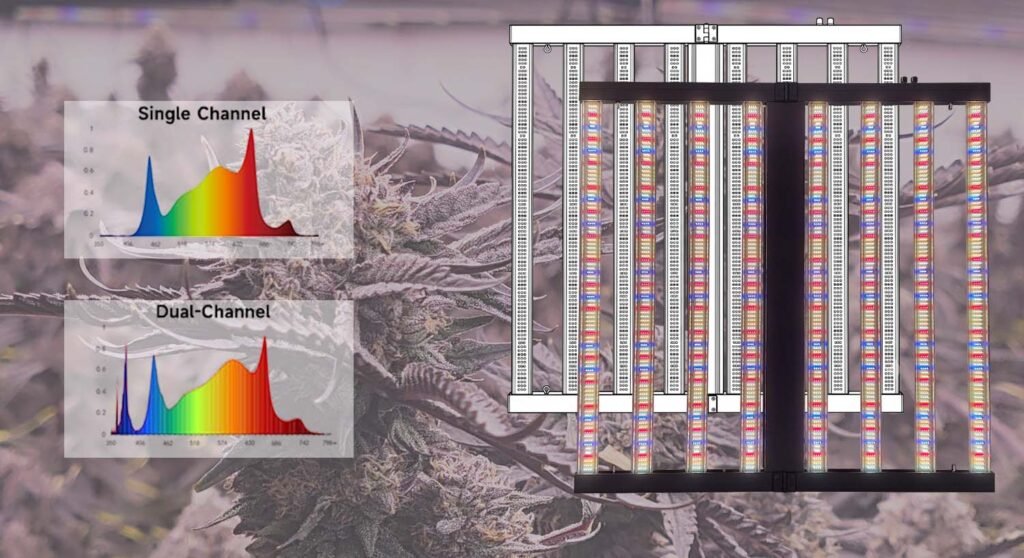
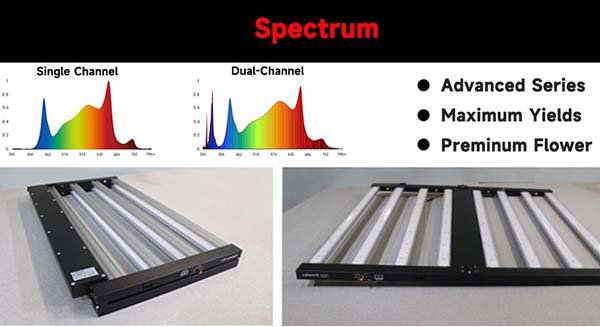
| Spectrum | Unreal full spectrum | True full sepectrum. and Single / Dual channel availble. |
| Fair Price | $499-$1200 USD (Brand Markup) | $168-$280 USD (Direct Factory Price) |
The 6-Bar vs. 8-Bar Breakdown: How Diode Dictates Your PPE and Uniformity
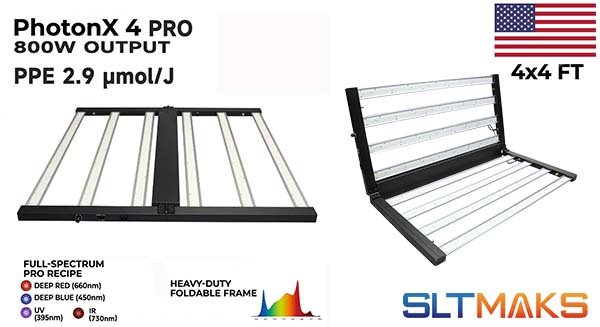
When selecting an 800W foldable fixture, the most common commercial choice you will face is deciding between a 6-bar setup and an 8-bar setup. A generic AI will tell you "more bars are better," but as a professional grower, you need to know exactly how this physical configuration changes your PPE metric and your 4x4 ft grid distribution.
An authentic commercial-grade 800W light strictly requires an 8-bar open configuration over a 6-bar setup to achieve a premium PPE 2.8 to 3.1 μmol/J. By spreading 800W of power across more individual high-bin diodes, the chips run under-current, delivering 15% better spatial light uniformity and eliminating cold edges.
The PPE Cheat Code: More Diodes = Lower Current = Lower Electric Bills
Why does an 8-bar 800W light out-perform a 6-bar light, even when they draw the exact same 800W from your wall socket? It all comes down to diode density, driving current, and a fundamental law of semiconductor physics known as the "LED Droop Effect."
According to official engineering datasheets from top-tier diode manufacturers like Samsung (for the industry-standard LM301B/LM301H chips), an LED’s light efficiency drops drastically as you pump more electrical current through it. The scientific curve proves that the lower the current, the higher the photon efficiency (2.8 to 3.1 μmol/J).
- The 6-Bar Squeeze (Overclocked Diodes): To hit a true 800W output with only 6 bars, the factory has to use fewer total diodes and push them harder with a higher electrical current. When you overdrive a diode, the electrons choke and collide violently inside the semiconductor layer. This converts a massive chunk of your expensive electricity into useless room heat instead of usable plant light. Your efficiency drops to a weak 2.6 μmol/J.
- The 8-Bar Efficiency Sweet Spot (The Under-Current Win): An 8-bar layout gives the factory more physical aluminum surface area to mount premium, high-bin diodes (like Samsung or Osram). Because there are significantly more diodes sharing that 800W workload, each individual chip is driven under-current (30% - 40% of its physical maximum limit). Diodes absolutely love this. They run cool, operate at peak PPE (2.8 to 3.1 μmol/J), and convert every cent of your power bill into clean photon energy.
In the real world, under the exact same 800W utility bill, our 8-bar under-current architecture delivers 10% to 15% more total usable photons (PPF) to your plants than an over-driven 6-bar light. You are getting free light energy and a slashed air-conditioning load, purely by utilizing real semiconductor engineering.
4x4 ft Uniform Lighting
The 800W foldable configuration is the undisputed standard king for 4x4 ft rolling benches, multi-tier vertical farming racks, and heavy-yield grow tents. But light distribution behaves completely differently between 6 and 8 bars across this grid, 8-bar model is of perfect edge-to-center balanced
With an 8-bar configuration, the physical light-emitting bars are spaced closer together and sit right on the outer margins of your 4x4 footprint. Instead of creating a blinding hotspot in the dead center and leaving dark pockets in the corners, the photon distribution graph is completely flat. This ensures that the plants sitting on the outer edge of your rolling bench receive the exact same high-energy photon intensity as the plants sitting right under the middle of the light. Every square inch finishes uniformly, increasing your total weight per square foot by over 15% to 20% simply by rescuing your perimeter crops from light starvation.
800W Foldable Bars vs. Gavita 1930e Style Modules: The Ceiling Height Ultimatum
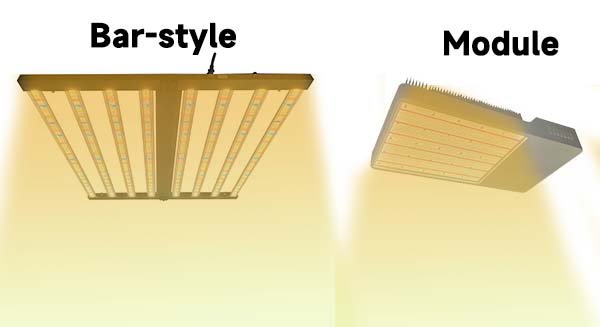
When sourcing an 800W fixture, you will also encounter heavy industrial Module lights (like the famous Gavita 1930e style). While they pack a massive 800W punch, deploying them in the wrong facility footprint is a fatal mistake.
【 800W FACILITY MATCH 】
🌟 800W Foldable Bars ──► Low Clearance / Vertical Racks / Tents (Hang close: 12"-24")
🏢 Gavita 1930e Module ──► High Clearance / Commercial Greenhouse Only (Hang far: 4-6ft)
- The Gavita 1930e Style Module (High-Ceiling Greenhouse King): These fixtures are designed to be compact, high-intensity direct replacements for old 1000W HPS lights. They throw an incredibly intense, laser-focused beam of photons downward from a small physical footprint.
- The Trap: They strictly require huge ceiling clearance (at least 4 to 6 feet or more above the canopy) to allow the cone of light to spread out naturally. If you hang a 1930e-style module inside a standard vertical rack or a 7-foot home tent, it will instantly act like a magnifying glass under the sun - bleaching and frying your top colas while leaving the sides dark.
- The 800W Foldable Multi-Bar (The Multi-Tier & Tent Chameleon): Because the 8 bars spread the 800W across a wide 4-foot by 4-foot aluminum frame, the crossover light beams are already mixed before they even leave the diodes.
- The Real-World Win: You can hang our 8-bar foldable fixture as close as 12 to 24 inches from your plant canopy without a single microsecond of light burn. This makes it the absolute undisputed king for multi-layer vertical shelves, rolling benches with limited vertical clearance, and high-end indoor tents where every inch of height is money.
Driver Topology and Electrical Engineering: Built-In Frame vs. Heavy-Duty Power Enclosure
Once you select an 8-bar layout with premium PPE and a solid spectrum, the next critical engineering variance is the driver configuration. In the 800W commercial tier, the market splits into two highly successful, fully potted engineering formats: the ultra-clean Built-in Frame layout and the classic Heavy-Duty Power Enclosure.
【 DRIVER CONFIGURATIONS 】
- Built-in Frame ──► Cleanest Aesthetics ──► Saves Vertical Space ──► Ideal for Multi-Layer Racks
- Heavy-Duty Enclosure ──► Industrial Sosen Driver ──► PF >98% / High Repairability ──► King of Commercial Benches
The Built-in Frame Driver Setup: The King of Vertical Space and Clean Lines
- The Engineering: In this layout, the factory splits the 800W power system into low-profile, slimline drivers that are customized to slide directly inside the aluminum side profiles of the light's frame. These drivers are fully potted with thermal conductive gel for water-resistance and heat dissipation.
- Advantages:
- Ultra-Clean Integration: To anyone walking into the room, this fixture looks like it has no power supply at all. There are zero bulky boxes sitting on top and no complex wiring harnesses. It creates an incredibly neat, modern cultivation facility.
- The Vertical Farming Savior: Because the drivers are flushed into the side frames, the vertical profile of the light is incredibly slim. For multi-layer vertical racks where every quarter-inch of height directly affects plant-to-light clearance, this design saves invaluable space. It is also highly budget-friendly, making it a great option for minimizing initial hardware setup costs (CAPEX).
- The Trade-offs to Keep in Mind: Because these smaller drivers are locked away inside the frame, their peak electrical conversion efficiency sits slightly below that of large-scale industrial drivers. Furthermore, if a driver component fails down the road, opening up the sealed frame and replacing the potted micro-driver is a more labor-intensive maintenance process than unbolting a standard power box.
The Heavy-Duty Power Enclosure: Overbuilt for Maximum Efficiency and Grid Stability
- The Engineering: This classic commercial architecture features a thick, heavy-duty metal power enclosure bolted running down the center spine of the foldable bar system.
- Advantages:
- Premium Power Factor (PF >98%): Running an industrial-grade driver allows this setup to lock in a Power Factor greater than 98% ((PF >0.98)). Almost 100% of the electrical energy pulled from your wall panel is converted into active photosynthetic work with virtually zero reactive power wasted. This eliminates commercial billing line leaks and ensures your circuit breakers run rock-solid without tripping under massive multi-light loads.
- Industrial Efficiency & Easy Maintenance: These large-format drivers feature larger internal capacitors and heavier potting surfaces, leading to better overall thermal management and top-tier lifespan. If a component ever encounters an issue after years of service, swapping or repairing the single power box is a simple "plug-and-play" process without touching the light's core structure.
Photobiological Spectrum and Multi-Channel Evolution: The Potency and Yield Engine
When looking at a professional 800W spectrum layout, you aren't just buying "bright white light." You are buying an engineering tool that drives plant photomorphogenesis—the biological way light shapes crop growth. In the 800W tier, the real division between a basic budget lamp and a high-yield commercial harvest engine comes down to wavelength grading, diode selection, and how many independent channels you control.
【 SPECTRUM EVOLUTION MATRIX 】
🥉 Entry-Level ──► Full Spectrum White + Deep Red 660nm (For general agriculture)
🥈 Mid-Tier ──► White + Deep Red 660nm + Blue 450nm (Add blue to build incredibly thick, sturdy stems and tight internodal stacking)
🥇 Elite-Tier ──► White + Deep Red + Blue + INDEPENDENT UV & IR Channels (Mainly for high-value economic crops)
Wavelength Breakdown: The Evolution of Commercial Light Recipes
Not all 800W spectra are configured the same way. The industry has clearly evolved into three distinct tiers based on the botanical precision required by the grower:
- The Baseline (White + Deep Red 660nm): This is the entry-level standard layout. It uses full-spectrum white diodes (like 3000K and 6500K) as a sunlight baseline, mixed with a set amount of Deep Red (660nm) to boost flowering. It gets the job done for general agriculture but offers no phase-specific tweaking.
- The Pro-Grower Upgrade (White + Deep Red + Blue): This mid-tier configuration adds targeted 450nm Deep Blue chips into the mix. Pumping extra blue photons during the vegetative stage forces the plant to build incredibly thick, sturdy stems and tight internodal stacking (keeping the plant short, stocky, and structurally primed for heavy bud loads without snapping).
- The Master Elite Standard (White + Deep Red + Blue + Independent UV & IR): This is the absolute peak of modern cultivation tech, engineered for high-value economic crops, premium medical herbs, and top-tier breeding labs where terpene profiles, potency, and harvest speed dictate millions in profit.
The Power of Independent UV and IR Control: Weaponizing Light Signals
On our elite-tier 800W platforms, UV (Ultraviolet) and IR (Infrared/Far-Red) are wired into completely independent, isolated electrical circuits with their own dedicated switches or dimming knobs. They are never mixed into the main full-spectrum line to run blindly all day, because these wavelengths act as powerful biological triggers that must only be flipped on at precise times:
- IR (Far-Red 730nm) – The "Sunset Protocol" & Harvest Shortener:
- The Emerson Effect: When you run 730nm IR alongside 660nm Deep Red, it triggers the Emerson Enhancement Effect. The plant’s overall photosynthetic rate skyrockets, performing far better than running each wavelength alone.
- Tips: By controlling IR independently, you can run an engineering trick called the "Sunset Protocol." Turning the independent IR channel on for 15 to 30 minutes right as the main lights go dark fools the plant's phytochrome system into entering its "dark sleep cycle" instantly. In standard setups, it takes a plant 1 to 2 hours to wind down into night mode. This trick literally saves you up to 2 hours of botanical metabolic time every single day, allowing you to shorten your total flower cycle by 7 to 10 days per harvest!
- UV (UVA/UVB 385-395nm) – The Resin and Potency Squeezer:
- The Stress Shield: Ultraviolet light is actually a form of controlled radiation stress. When a plant senses UV photons, its survival mechanism kicks in and it creates a natural "sunscreen" to protect its tissues.
- The Terpene Explosion: This botanical sunscreen is composed of pure, concentrated trichomes, heavy resins, and rich terpenes. By keeping the UV channel switched off during early growth (preventing stunted growth) and slamming it on only during the final 2 to 3 weeks of the flowering flush, you force the plant to hyper-produce frost, intense aromas, and peak potency.
Breaking the Brand Markup: Sourcing Your 800W Engine Directly from the Source
Now that you know how to audit an 800W foldable fixture like a senior electrical and botanical engineer, it’s time to talk about the final, most satisfying metric: the financial invoice (CAPEX).
【 SUPPLY CHAIN TRUTH / 800W 】
US Overseas Label Brand: ──► Factory Cost ($180) ──► Ocean Freight ($30) ──► Marketing & Middlemen ──► Retail Price ($800 - $1,200)
CN Factory Direct: ──► EXW Price ($180)
Many growers believe that spending $800 to $1,200 USD with a famous Western brand name guarantees they are getting a superior "space-grade" 800W light. As a source manufacturer, let us tell you the honest truth of the global supply chain:
- The Shell Game: Over 95% of those high-end, heavy-duty 800W foldable grow lights sold by Western brands are designed, engineered, and manufactured right here in specialized Chinese production hubs.
- What You Are Actually Paying For: When you buy from a middleman brand, the physical light costs around $180 to $250 USD at the factory gate. The rest of your $1,000 invoice goes to pay for their flashy Instagram influencer campaigns, expensive Western exhibition booths, multi-tier distributor markups, and high corporate overhead. The plants under the light don't care about a luxury brand logo; they only care about the real photons hitting their leaves.
By bypassing the middleman and partner-sourcing directly with a genuine manufacturing factory, your commercial ROI (Return on Investment) instantly shifts into hyper-drive.
Stop paying a premium for luxury brand stickers that do nothing for your harvest weight. Tell us your ceiling height, your crop type, and your rack layout. Let’s build the exact 800W multi-bar setup.