
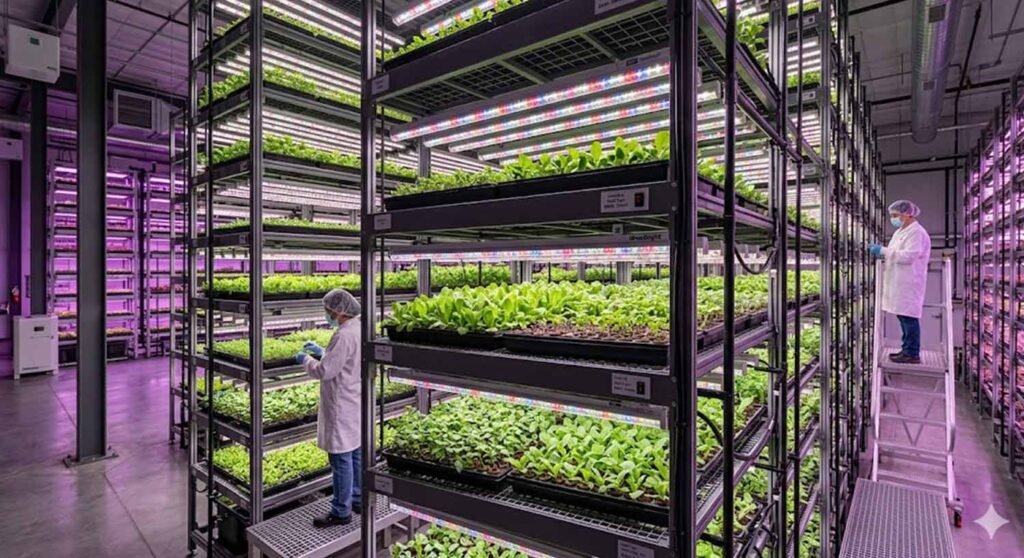
In the world of commercial cultivation, the seedling stage is a race against time. Whether you are running a vertical farm for leafy greens or a high-value nursery, every day a tray sits on the rack is a day of overhead costs.
Traditionally, growers waited 14 days or more for seedlings to be "ready." Today, with advanced LED spectral engineering, we are shifting the focus from "waiting for growth" to "compressing the cycle."
Grow Lights Can Help to Compress the Seeds Growth Cycle
How LED Grow Light Precision Steals Time Back?
By providing 18 to 24 hours of consistent, optimized light, it can ensure the plant's photosynthetic engine is running at peak efficiency from the moment the first leaf emerges. Unlike sunlight, which is inconsistent, LED allows us to hit the ideal Daily Light Integral (DLI) in a shorter window.
- Faster Transplants: Shrinking a 14-day cycle down to a week means you can fit more rotations per year into your facility.
- Space Optimization (The "Thin" Advantage): In multi-layer propagation, every centimeter of vertical clearance counts. Professional LED bars are designed with an ultra-slim profile and low heat output. So you can choose to reduce the distance between layers, allowing you to stack 10 levels of seedlings where others can only fit 6, to grow more.
What Grow Light Color is Best for Seedlings?
A common mistake is treating all seedlings the same. At our planting experiment, we've learned that a "generic" light is often the enemy of efficiency. Not al "babies" eat the same, crops and seeds have different specific requirements.
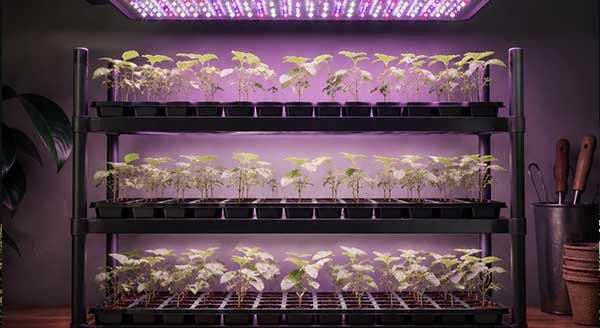
Vegetables & Leafy Greens: The "Sturdy" Focus
In commercial vegetable production, a "tall" seedling is often a "weak" seedling. What every farm manager looks for is a compact, thick-stemmed plant with deep green leaves. This is what we call "sturdy" growth.
A. The Science of Anti-Legginess
When seedlings don't get enough of the right wavelengths, they undergo Etioaltion - stretching their stems desperately to reach a light source. This leads to leggy plants that collapse under their own weight or during transplanting.
- The Blue Light "Anchor": To counter this, we engineer our nursery spectra with a strategic spike in Blue (450nm). Blue light triggers the cryptochromes (photoreceptors) in the plant that tell it to stop stretching and start strengthening. It acts as a biological brake on vertical height, forcing the plant to build a thicker cell wall and a hardier stem.
B. Nutrient Loading & Root Foundation
A sturdy seedling isn't just about the stem; it’s about what’s happening underground and inside the leaves.
- Chlorophyll Density: High-intensity, full-spectrum LED light promotes the development of thick, dark green leaves with high chlorophyll content. This means the plant has a larger "solar panel" to feed itself immediately after being moved to the next growth stage.
- Root-to-Shoot Ratio: By optimizing the Red-to-Far-Red ratio during the final days of the nursery phase, we can signal the plant to expand its root system. A sturdy plant with a massive root ball will survive the transplant shock much better than a greenhouse-pampered weakling.
C. The Commercial Impact: Machine-Ready Seedlings
Modern agriculture relies on automated transplanters. If the seedlings are too tall or inconsistent in height, the machines will damage them.
- Uniformity is Key: Professional LED arrays provide uniform PPFD across the entire tray. This ensures that every single seedling - from the center to the very edge - is the exact same height and thickness.
- Reduced Mortality: Sturdy plants have higher survival rates. Reducing your mortality rate by even 5% through better lighting can pay for the entire lighting system in just a few harvest cycles.
Marijuana: From Seeds to Strong Starts
For high-value crops like marijuana, the nursery phase is the foundation of the entire plant's potential. A strong seedling stage ensures a robust vascular system that will later support heavy, resinous buds.
Building the "Solar Panel"
A marijuana seedling is hungry for structural integrity. From the moment the cotyledons (first small leaves) open, the plant is looking for a signal to build its "solar panel."
- PPFD Ramping & Metabolic Training: Seedlings need a steady increase in intensity. We can start setting at a soft 150 μmol/㎡/s and gradually ramp up to 300. This is not just about light; it is "metabolic training." By gradually increasing the photons, we harden the leaf cuticle (the protective outer layer), preparing the plant for the high-intensity flowering lights it will encounter later.
- The "Squat" Growth Strategy: To prevent your expensive seeds from turning into weak, spindly stalks - a common failure known as "stretching" - we focus on the Blue-to-Red ratio. High Blue photons (450nm) suppress Gibberellin (a plant hormone that causes cell elongation). By providing a Blue-rich spectrum in the first 10 days, we can force the plant to remain "squat" - wide and sturdy, with short internodal spacing. A squat plant with short nodes provides a maximum number of branch sites. When we eventually flip to the vegetative and flowering stages, this structural foundation directly leads to a higher density of bud sites.
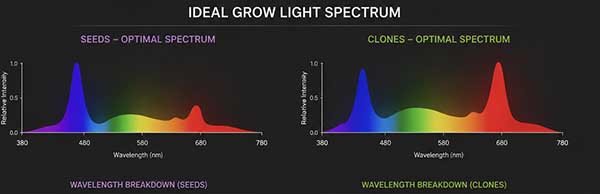
A Note on Clones: The Specialized Alternative
While many start with seeds, commercial facilities often use Clones (Cuttings) to ensure genetic consistency. However, a clone is biologically different - it is a plant in survival mode.
- The "Energy Deficit" Logic: Unlike seedlings that have a taproot to pull nutrients, a clone is an island. If the light is too intense, the leaves will attempt to drive photosynthesis. Without roots to replenish the lost water and nutrients, the clone will "self-cannibalize," pulling Nitrogen from its own leaves to try and survive, leading to rapid yellowing.
- Low-DLI Recovery: Clones require much lower light intensity (75-125μmol/㎡/s). We can choose dedicated propagation bars with a diffuse, soft white spectrum. This gentle energy is just enough to keep the plant alive while it redirects all its internal hormonal signaling to root primordia development (growing roots) rather than leaf expansion.
Grow Light for Seed Starting Achieving "Sovereignty Over Biology"
The real evolution from sunlight to LED isn't just about brightness; it's about sovereignty over biology. Sunlight is a gift, but it is unpredictable. When we talk about grow light for seed starting, we are no longer just helping plants grow - we are using LED systems as a biological remote control to dictate their future.
Filtering the "Noise" of Nature
In a natural environment, seedlings are often victims of their own survival instincts. For example, natural sunlight at dawn or in the shade contains a high ratio of Far-Red light (730nm).
- The Problem: High Far-Red signals to the seedling that it is being shaded by competitors. This triggers Etiolation (stretching), where the plant desperately elongates its stem to find more light, resulting in a weak, spindly stalk that can barely support itself.
- The LED Grow Light Solution for Seeds: By selecting a spectrum rich in Blue (450nm) and limiting unnecessary Far-Red during the first week, we filter out the "noise" of the forest floor. We provide a clear, unambiguous signal that tells the plant: "Stay short, grow thick, and build your strength."
Erasing the Seasons: The Power of Predictability
For a commercial grower, time is the most expensive nutrient. In a traditional solar-dependent nursery, your production schedule is at the mercy of the weather. A batch of seeds might take 14 days in July but 22 days in the gray shadows of January.
- Sovereignty Over the Calendar: Using high-precision Grow Lights for Seed Starting allows you to erase seasonality. By maintaining a consistent Daily Light Integral (DLI), we can turn oyr facility into a 365-day-a-year "Summer Solstice."
- Industrial Precision: This predictability allows for "Just-in-Time" delivery. You can guarantee to your clients (or our your flowering rooms) that your seedlings will be at the exact height and node count required, on the exact day promised - regardless of the storm raging outside.
"Metabolic Training": Hardening Before the Move
The transition from the nursery (low light) to the flowering room (high intensity) is a traumatic event known as Transplant Shock. A sovereign lighting strategy uses the pre-transplant window to program the plant for this shock.
- Pre-Conditioning the Vascular System: During the final 48 hours of seed starting, you can choose to ramp up the light intensity and blue photons. This "metabolic training" forces the plant to thicken its leaf cuticle (the protective waxy layer) and expand its vascular bundles (the plant's circulatory system).
- The Result: Near-Zero Lag: While competitors' plants may stall for 3-5 days after transplanting as they struggle to adapt, your plants will resume vigorous growth within hours. In a high-volume facility, eliminating those 3 days of lag per cycle can result in an entire extra harvest per year.
At the end of the day, commercial growing is the art of eliminating variables. While the sun is a gift, LED is a tool of certainty. We don't just give your seeds light; we give your facility a predictable heartbeat. Because in this business, a predictable cycle is the shortest path to a profitable harvest. At SLTMAKS, we believe the best grow light is the one that tells your plants exactly who they need to be, long before they leave the nursery.
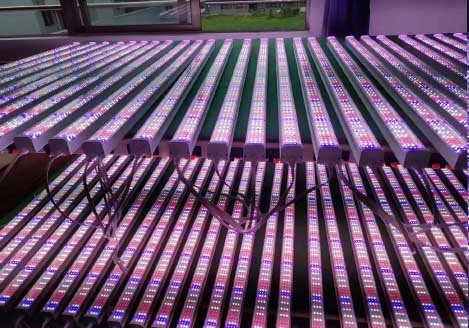
Sourcing Led Grow Light for Seeds - Customization & Industrial Reliability
To achieve this level of "Biological Sovereignty," you need more than just a light; you need a tool designed for the rigors of an industrial nursery. And when you reach a certain scale, buying "off-the-shelf" lights from retail platforms becomes a limitation. This is where moving from a consumer mindset to a partnership mindset with a manufacturer changes everything.
- Beyond the Catalog: Retailers sell one-size-fits-all spectrums. However, if your facility specializes exclusively in tomato seedlings or high-end cannabis clones. To achieve this level of "Biological Sovereignty," you need more than just a light; you need a tool designed for the rigors of an industrial nursery. At SLTMAKS, a 16-year manufacturing and 10-year grow lights experienced factory, we can design and produce the best grow lights match your specific crop's biological needs.
- Engineering for Vertical Density: In a commercial nursery, your real estate is measured in cubic centimeters. You can choose our ultra-slim profile LED bars to maximize your vertical stacking. By reducing the light's physical footprint, you can often fit an additional 2–3 layers of propagation racks in the same room height, effectively increasing your production capacity by 20-30% without expanding your building.
Industrial-Grade Resilience IP65 Waterproof: Seed starting and cloning environments are effectively "saunas" with high humidity. Most retail-grade lights fail here within months due to internal corrosion. You can choose our industrial-grade IP65 ratings grow light fixtures. At SLTMAKS, we build for longevity. Our lights are sealed against moisture and foliar sprays, ensuring that the humidity required for your seedlings' survival isn't the cause of your equipment's failure.
Reliability & Support: Unlike an anonymous Amazon seller, a 16-year factory like SLTMAKS provides industrial-grade reliability (IP65+) and direct technical support. When you buy direct, you aren't just buying hardware; you are buying the assurance that your production cycle will never be interrupted by equipment failure.
Conclusion: The Future of Cultivation is Built on the Seeds
In the grand cycle of a plant's life, the nursery phase is a relatively short window. Yet, as we have explored, these few days dictate the efficiency, the structure, and the ultimate profitability of your entire operation.
Choosing the right grow light for seed starting is no longer a matter of finding a light that works. It is about deciding whether you want to remain at the mercy of environmental variables or if you are ready to take sovereignty over biology. By eliminating the randomness of the seasons, optimizing vertical space, and programming the resilience of every seedling, you aren't just growing plants - you are engineering a high-performance production line.
At SLTMAKS, we understand that every tray of seedlings represents a promise of a future harvest. Our 16 years of industrial manufacturing are dedicated to ensuring that when you flip the switch, you are giving your seeds the best possible start in an unpredictable world.
Ready to take sovereignty over your next cycle?
Whether you are scaling a vegetable nursery or optimizing a high-value clone facility, our engineering expertise is at your service. Contact our team today for a custom lighting plan tailored to your facility's unique heartbeat.
FAQ
Q1: How far should I hang my LED bars from the seedlings?
- A: This depends on the intensity of your fixture. For nursery bars, the ideal distance is often between 6" to 12" (15-30cm). Because SLTMAKS fixtures are engineered for low heat output, you can position them closer to the canopy than traditional HID lights. This close-proximity lighting increases photon capture and allows for more vertical layers in your rack system, directly boosting your space efficiency.
Q2: Should I run my nursery lights for 24 hours a day?
- A: While it’s tempting to push for maximum speed, most seedlings benefit from a 18/6 or 16/8 photoperiod. Plants, especially in the sensitive seedling stage, need a dark period to complete essential metabolic processes and root respiration. A controlled dark period builds a more resilient plant that is better prepared for the natural rhythms of the flowering or fruiting stage.
Q3: Can I use the same lights for both seeds and clones?
- A: Physically, yes; biologically, you must adjust the intensity. Seeds can handle higher PPFD than rootless clones. If you use the same fixture, we recommend using a dimming system. By dimming the light to 30-50% for clones and ramping up to 100% for established seedlings, you can use dimmer or a control system for your entire propagation facility.
Q4: How do I know if my seedlings are getting too much or too little light?
- A: The plant will tell you. If they are stretching (long, thin stems), they need more intensity. If the leaves are curling down or showing bleached spots, the light is too intense or too close. The goal is a compact squat profile.