
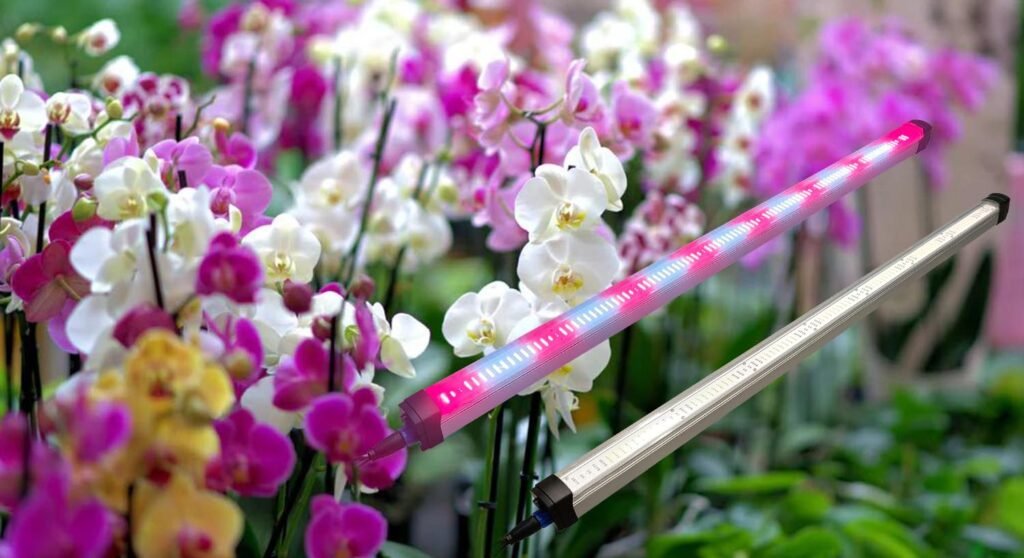
Orchids are among the most evolutionarily diverse plants on Earth, occupying ecological niches from misty rainforest floors to sun-drenched tree canopies. Because of this, a "one-size-fits-all" grow light is the most common reason for failed blooms. To succeed commercially, you must understand the Light Hierarchy.
Understanding the Lighting for Orchids
At SLTMAKS, we categorize orchid lighting into three distinct intensities based on their biological origins. We design and produce led grow Light for orchids which allows you to curate these micro-climates within a single facility:
- Low-Light Orchids (e.g., Phalaenopsis, Paphiopedilum): These "shade-dwellers" require soft, filtered light. In a natural rainforest, they receive dappled sunlight. Generic high-power lights often cause leaf scorching or "bleaching."
- Medium-Light Orchids (e.g., Oncidiums, Miltonias): The "middle class" of orchids. They need enough intensity to build energy but can still be sensitive to mid-day heat peaks.
- High-Light Orchids (e.g., Cattleyas, Dendrobiums, Vandas): The "sun-seekers." Without intense supplemental lighting, these species will remain perpetually vegetative—growing lush green leaves but never producing a single spike.
The biggest struggle for orchid hobbyists and commercial growers alike is the unpredictability of seasons. A week of heavy cloud cover during the critical "spiking" season can cause a whole crop of orchids to drop their buds (bud blast).
You can choose to eliminate this risk. By using high-precision LED grow lights, you provide a consistent Photoperiod that doesn't vary with the weather. You aren't just giving the plant photons; you are giving the plant metabolic stability.
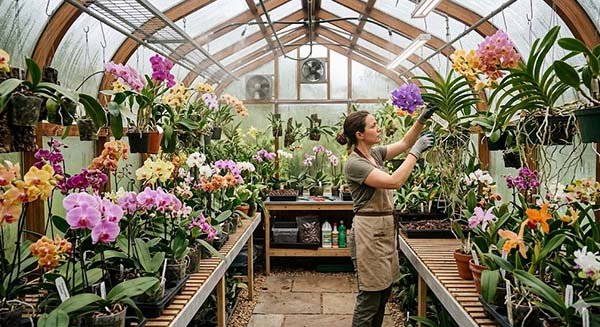
Spectral Engineering - The Biological Switch for Blooming
For orchids, light is more than energy; it is a language. To move an orchid from the vegetative stage (leaves) to the reproductive stage (flowers), you must deliver the right "message" through the spectrum. This is where generic white LEDs fail and where SLTMAKS spectral engineering excels.
The "Spiking" Signal: Deep Red & Far-Red Balance
The most critical transition in a commercial orchid nursery is Spiking - the moment the plant decides to initiate a flower stalk. In a natural canopy, orchids sense the changing of seasons through the ratio of Red to Far-Red light.
- Phytochrome Conversion: Orchids contain a protein called Phytochrome, which acts as a light-sensitive switch. Far-Red light (730nm) triggers a conversion that tells the plant it is time to transition from leaf production to flower development.
- Operational Control: Generic lighting often lacks a sufficient Far-Red component, keeping the plant in a perpetual "vegetative loop." You can choose fixtures with a targeted 730nm spike to synchronize this transition. This level of control allows for precise scheduling, ensuring that the entire crop reaches the spiking stage simultaneously to meet specific market windows.
Pigmentation & Anthocyanin: Why Color Matters
The market value of an orchid is dictated by the vibrancy of its color. A pale orchid is a discounted orchid.
- UV-A & Blue Light Influence: To achieve those deep purples, vivid reds, and striking spotted patterns, orchids require a specific dose of Blue (450nm) and even trace UV-A. These wavelengths stimulate the production of Anthocyanins (plant pigments).
- Balancing Intensity and Heat: While these short wavelengths are necessary for color, they must be delivered without excessive radiant heat. High temperatures can cause "bleaching" or premature wilting of delicate petals. Modern LED engineering allows for the delivery of these high-energy photons while maintaining a cool environment, ensuring the colors are "locked in" without compromising the flower's longevity. Our professional orchid arrays ensure that the Blue-to-Red ratio is balanced to prevent the "bleaching" effect caused by excessive intensity while ensuring the colors are "locked in" and saturated.
Photosynthetic Efficiency vs. Heat Stress
Orchids are unique among flowering plants because of their epiphytic nature. Their roots (covered in Velamen) and leaves are highly sensitive to the micro-environment's temperature and moisture levels.
- The Transpiration Balance: Traditional lighting sources often emit significant infrared heat, which dries out the orchid’s protective root layer and forces the stomata to close. When the plant is under heat stress, photosynthesis stalls, regardless of how much light is provided.
- The "Cold Light" Logic: By utilizing high-efficiency LED chips, it is possible to deliver the necessary light intensity (PPFD) with minimal heat radiation. You can choose such "cold light" solutions to preserve the 60-80% humidity levels that orchids require. This synergy between light and environment ensures that the plant remains metabolically active, supporting the development of thicker pseudobulbs and more robust flower spikes.
The Orchid Light Spectrum Guide - Specific Needs for Specific Species
To achieve optimal results, you must match the light intensity (PPFD) and duration to the specific genetic requirements of your orchid variety. Here is a detailed breakdown of the three lighting tiers at SLTMAKS:
Tier 1: Low-Light Orchids (100 - 200 µmol/m²/s)
These species are adapted to the shaded forest floor. Excessive light will quickly lead to chlorosis (yellowing) or permanent leaf tissue damage.
Primary Species:
- Phalaenopsis: The most popular commercial orchid. They require consistent, soft light to maintain lush green leaves and long-lasting blooms.
- Paphiopedilum: Known for their unique pouch, these slow-growers are extremely sensitive to heat and high-intensity spikes.
- Jewel Orchids: Grown primarily for their stunning foliage; low light preserves the deep, velvety textures of their leaves.
Operational Note: For this tier, we recommend a wider beam angle and higher mounting heights to ensure a diffused, "dappled" lighting effect.
Tier 2: Medium-Light Orchids (200 - 400 µmol/m²/s)
This group occupies the "Goldilocks zone." They need enough energy to develop thick pseudobulbs (water-storage organs) but must be protected from intense mid-day radiation.
Primary Species:
- Oncidium: Requires a balanced spectrum to encourage the mass production of its characteristic small, vibrant flowers.
- Miltonia: Famous for their pansy-like faces; they need consistent light to prevent "accordion growth" (wrinkled leaves).
- Intergeneric Hybrids: Many modern commercial hybrids fall into this category, requiring a stable DLI to ensure uniform crop timing.
Operational Note: Dimming capabilities are essential here. You can choose to ramp up intensity during the pre-blooming phase to provide the extra energy needed for flower spikes.
Tier 3: High-Light Orchids (400 - 600+ µmol/m²/s)
These are the "power consumers" of the orchid world. Without intense supplemental light, they will often fail to bloom entirely in indoor or greenhouse settings.
Primary Species:
- Cattleya: Known as the "Queen of Orchids." High light is the primary trigger for its large, fragrant, and high-value blooms.
- Dendrobium: Especially the nobile types, which require high light and a cool "rest period" to initiate buds along the canes.
- Vanda: These are often grown with bare roots hanging in the air; they require the highest intensity (often exceeding 600 µmol) to sustain their rapid metabolism and vibrant colors.
Operational Note: For these "sun-seekers," the spectrum must be reinforced with deep red to sustain the high metabolic demand without the burning heat of traditional HPS lamps.
Sovereignty Over Biology - Predictability and Spatial Optimization
The true value of advanced LED systems in orchid cultivation lies in sovereignty over biology. For a commercial nursery, this means moving away from "adapting to nature" and moving toward "commanding the cycle." It is the transition from a seasonal hobby to a synchronized industrial process.
Erasing Seasonality: The Precision of the Photoperiod
Many high-value orchids, such as Cymbidiums and Cattleyas, are photoperiod-sensitive. In a traditional greenhouse, their blooming is dictated by the natural decrease in day length, limiting harvests to specific times of the year.
- Breaking the Calendar: By utilizing LED as the primary light source, you can choose to simulate any season at any time. By precisely controlling the "on/off" cycle, you effectively dictate the plant's internal clock. This allows a facility to bring orchids to market during high-demand windows (such as Lunar New Year or Valentine's Day), regardless of the actual season outside.
- Uniform Delivery: Sovereignty also means consistency. While sunlight varies from a cloudy Monday to a sunny Tuesday, LED provides a constant Daily Light Integral (DLI). This ensures that every plant in the facility follows the exact same growth trajectory, leading to a "machine-ready" harvest where every flower is at the same stage of openness upon delivery.
Vertical Farming
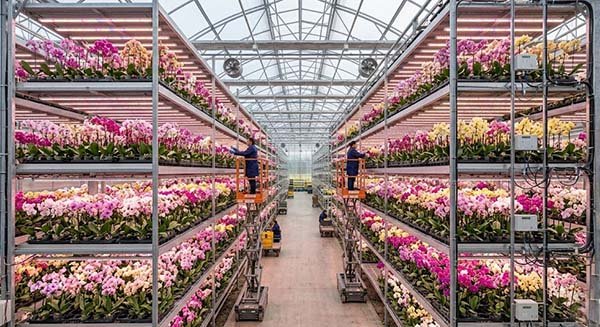
In many premium orchid-producing regions, land and facility costs are significant. Traditional lighting, due to its heat and bulk, forces a single-layer horizontal layout. Sovereignty over biology includes sovereignty over your physical space.
- Volumetric Productivity: Because modern LED bars can be engineered with an ultra-slim profile and low heat radiation, the vertical gap between layers can be minimized.
- The Multi-Tier Advantage: You can choose to stack your orchid racks 3, 4, or even 5 layers high without risking heat damage to the delicate top leaves. This triples or quadruples the production capacity per square meter. In an industrial nursery, this shift transforms the business model from "expanding the building" to "optimizing the volume," significantly lowering the overhead cost per bloom.
The SLTMAKS Philosophy: Control is the New Yield
At the end of the day, commercial orchid growing is the art of eliminating variables. While the sun is a gift, LED is a tool of certainty. We don't just give your orchids light; we give your facility a predictable heartbeat. At SLTMAKS, we believe the best grow light is the one that tells your plants exactly who they need to be, long before the first bud opens.
Conclusion:
In the world of professional floriculture, orchids represent the pinnacle of both biological complexity and market value. By transitioning from traditional, unpredictable lighting to an engineered LED strategy, you are doing more than just saving energy. You are choosing to synchronize your spiking cycles, intensify your floral pigmentation, and maximize your vertical production space. Whether you are cultivating delicate Phalaenopsis or light-hungry Vandas, the goal remains the same: Certainty in every crop.
At SLTMAKS, we understand that in the orchid business, beauty is the product, but precision is the engine. Our 16 years of manufacturing expertise are dedicated to providing the reliable "heartbeat" your facility needs to turn potential into profit.
FAQ
Q1: Can I use the same LED grow light fixture for different orchid species?
- A: Yes, provided the grow light fixture has high-quality dimming capabilities. Since Phalaenopsis and Cattleyas have vastly different PPFD requirements, a dimmable SLTMAKS system allows you to adjust the output to match the specific "tier" of the orchid you are growing, making your investment much more versatile.
Q2: How does LED lighting affect the longevity of the flower after it opens?
- A: LED's "cold light" advantage is crucial here. Unlike HID lamps that emit infrared heat and cause flowers to transpire too quickly (leading to premature wilting), LEDs allow the flower to maintain its internal moisture. This often results in a longer "vase life" or shelf life, which is a significant competitive advantage for commercial sellers.
Q3: Is Far-Red (730nm) light necessary for all orchids?
- A: While all orchids use Far-Red to some extent for their circadian rhythms, it is especially critical for un-synchronized crops or species that are stubborn to bloom. If your goal is to hit specific holiday market windows, 730nm acts as the "scheduling tool" to trigger spiking on command.
Q4: Does LED lighting change the fragrance profile of scented orchids?
- A: Fragrance in orchids is linked to terpenes and volatile oils, which are influenced by light intensity and spectrum. By providing a full-spectrum environment that includes specific blue and red ratios, you support the plant's metabolic pathways responsible for oil production. Unlike HPS lights, which can "burn off" delicate volatile scents through excessive heat, LEDs preserve the cool environment necessary for orchids to retain their fragrance longer.
Q5: Can I use your LED grow lights to replace natural sunlight entirely in a windowless facility?
- A: Absolutely. This is the essence of "Controlled Environment Agriculture" (CEA). In fact, moving to a sole-source lighting model often produces more consistent results than a greenhouse because you eliminate the "noise" of cloud cover and seasonal shifts. Our spectral recipes are designed to provide the complete range of photons required for the entire life cycle - from the first flask to the final bloom - enabling high-density urban orchid farming.