
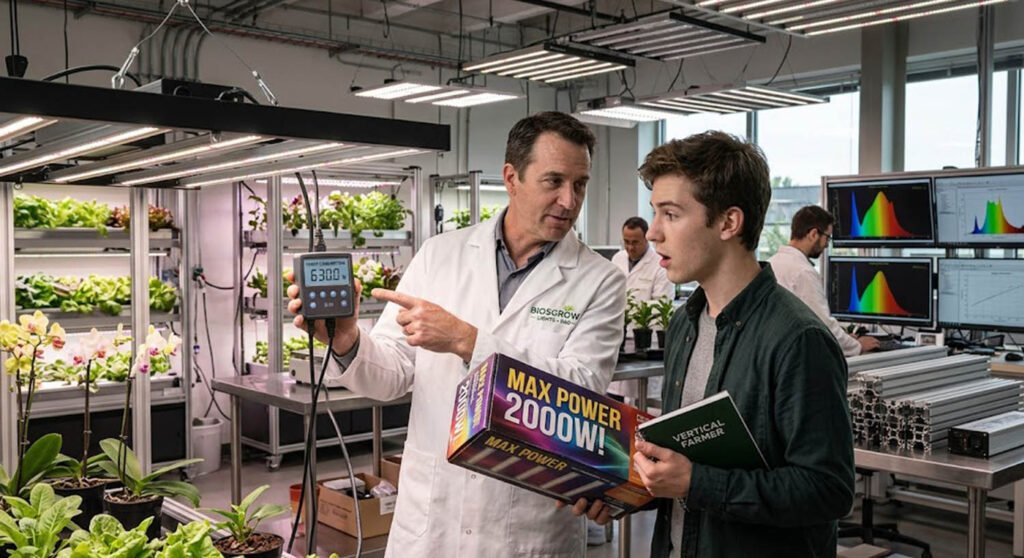
Introduction: The "2000W" Illusion in Commercial Horticulture
As a genuine, B2B-focused LED grow light manufacturer, our sales and engineering teams field inquiries from international buyers every single day. Lately, we’ve noticed a rising, highly confusing trend among hobbyists-turned-commercial growers and newly minted purchasing managers. They often approach us with a specific request: "I need a quote for a 2000W LED light for my indoor grow facility."
Whenever we hear this, our engineers have to pause and deliver a heavy dose of industry reality.
In the world of commercial, industrial-grade horticulture, there is virtually no single grow light fixture or quantum board that pulls a true, sustained 2000 watts from the wall. So, where is this number coming from?
The answer lies in the wild west of consumer e-commerce platforms like Amazon, eBay, and AliExpress. If you search for grow lights there, you will be flooded with cheap, lightweight panels boldly boasting "1000W," "2000W," or even "3000W" on their colorful packaging - all retailing for a suspicious $40 to $180.
But when these buyers transition into serious B2B sourcing and look at our spec sheets for a heavy-duty, commercial-grade 800W multi-bar fixture, they get confused. "Why does your 800W light cost several times more than an Amazon 1000W light?" they ask.
It’s time to pull back the curtain on "Marketing Watts" and explain why honesty in B2B engineering might look "weak" on paper to an untrained eye, but is the only way to safeguard your commercial ROI.
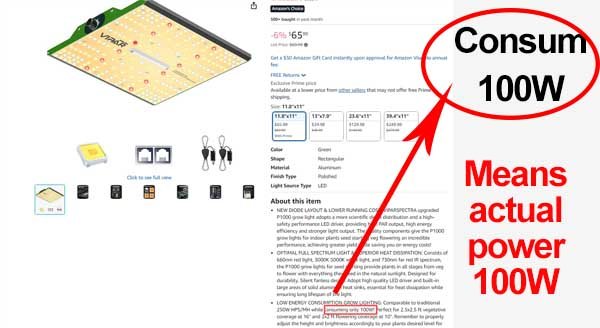
What Exactly Are "Amazon Watts" and Why Do Sellers State That?
To understand the confusion, you need to understand the deceptive math used by retail-grade consumer brands to trick hobby growers. In the B2C e-commerce space, sellers have coined their own definition of wattage, which genuine engineers refer to as "Theoretical Max LED Capacity" or simply "Marketing Watts."
Here is how the trick works:
Imagine a manufacturer builds a budget light panel and loads it with 200 pieces of 10-watt LED chips. Through basic multiplication, the marketing department claims:
200 chips × 10W = 2000W
They print "2000W MAX POWER" in massive letters on the box and paper.
The Industrial Reality Check
But here is what they don't tell you: LED chips are never driven at their theoretical maximum capacity. If a factory actually forced 10 watts of power into each of those budget chips on a thin aluminum plate, the heat generated would be catastrophic. Within seconds, the junctions would overheat, the phosphor would degrade, and the entire light fixture would literally melt or burn out.
To keep the fixture alive and prevent it from becoming a fire hazard, consumer-grade manufacturers severely underdrive the LEDs. They tune the internal driver to supply only a fraction of the current - often running a chip at just 0.5 to 1 watt.
Therefore, that heavily advertised "2000W" light panel is actually only drawing about 150W to 200W of actual electrical power from the wall. The remaining 1800W exists only in the imagination of their marketing team. For an amateur tent grower, a 150W true output might suffice for a couple of plants. But for a commercial business planning a multi-tier vertical farm or a large-scale greenhouse operation, relying on "Marketing Watts" is a fast track to crop failure and financial ruin.
The Evolution of Lies: From 2017 "Dual-Chip" to Modern Mid-Power LEDs
To truly understand how absurd these "2000W" claims are, we need to take a quick look at the history of LED grow light manufacturing.
The 2017 "Dual-Chip" Nostalgia
Around 2017, the first generation of affordable LED grow lights hit the market. These were the notorious, loud, purple-glowing (Blurple) boxes equipped with heavy internal cooling fans.
- The "Dual-Chip" Trick: Manufacturers back then used old Epileds or Bridgelux "Imitation Lumen" lamp beads. They would package two 5-watt silicon chips into a single diode, call it a "10W Dual-Chip," and slap 100 of them onto a board to claim a "1000W" or "2000W" fixture.
- The Fatal Flaws: These 2017-era fixtures were notoriously inefficient. They required massive, noisy built-in fans just to keep from melting, their light distribution was extremely uneven (creating harsh hot spots and dead zones), and their actual PAR output per watt was abysmal.
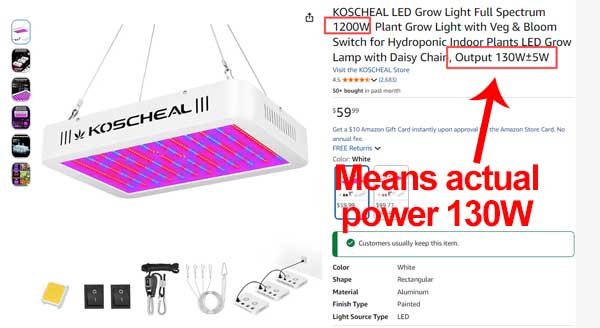
The Modern B2B Standard: Samsung & Ledstar
Fast forward to today. The commercial horticulture industry has completely evolved. Top-tier, professional B2B manufacturers - including our own factory - now utilize industry-standard, high-efficiency, mid-power SMD (Surface Mount Device) chips from premium brands like Samsung, CREE and Ledstar (Samsung )
In the product catalogs of Samsung or Ledstar, there is no such thing as a "10W commercial grow light diode."
Modern commercial cultivation relies on thousands of tiny, highly efficient chips (like the Samsung LM301H or Ledstar horticulture series) spread across large aluminum bars to achieve passive, fanless heat dissipation and perfectly uniform light coverage.
Even if a true 10W single diode existed in modern horticulture, driving it at full power would create a localized heat zone so intense it would fry the chip instantly. Anyone still advertising "10W dual-chips" is selling you outdated, noisy, inefficient 2017 technology disguised as modern equipment.
The 2026 Landscape: Breaking the "Samsung Monopoly" Myth - Samsung Exits from the Chinese market in 2025
For years, the commercial horticulture gold standard was dominated by Samsung's premium mid-power chips, specifically the LM301B, LM301H, and LM301H EVO. However, serious commercial buyers need to be aware of a massive supply chain shift that occurred recently.
Following Samsung's restructuring and exit from the Chinese market, china domestic factories can no longer easily source or manufacture fixtures utilizing those specific imported high-end LM301B/H/EVO series.
As a transparent, tier-1 manufacturer, we believe in telling our B2B clients the absolute truth rather than masking shortages with fake specs:
- The Samsung LM281B Reality: While the imported 301 series has faced severe supply constraints in mainland manufacturing, the highly reliable Samsung LM281B series continues to be produced domestically. We still maintain a premium, stable stock of genuine LM281B chips to deliver excellent, cost-effective performance for standard commercial layouts.
- The Rise of High-Performance Alternatives (CREE & Ledstar): For next-generation, high-efficiency, or high-PPE commercial projects that previously required the 301 series, the industry has successfully pivoted. We have engineered our latest flagship fixtures using CREE (the legendary American semiconductor giant) and Ledstar (the reigning champion of dedicated horticulture LED packaging).
In modern commercial testing, these specialized chips from CREE and Ledstar deliver PPFD uniformity and photon efficiency that easily match or exceed legacy Samsung setups, without the inflated import premiums.
In the catalogs of reputable giants like CREE or Ledstar, there is still no such thing as a "10W horticulture diode" run at full blast. Modern commercial cultivation relies on thousands of these highly efficient, mid-to-high-power SMD chips spread across large aluminum bars. This achieves passive, fanless heat dissipation and perfectly uniform light coverage. Driving any modern chip to a theoretical 10W would fry it instantly.
The B2B Dilemma: Why Honesty Makes Genuine Factories Look "Weak"
This technological gap creates a massive, frustrating dilemma for genuine B2B factories like us when dealing with buyers who are new to the commercial cultivation industry.
When an amateur grower or an inexperienced purchasing agent transitions from a hobby tent to a commercial facility, they bring their "Amazon mental scale" with them. They look at two quotes side-by-side:
| Specification | The Amazon / Consumer Retail Listing | Our Industrial Commercial Fixture |
| Advertised Wattage | 1000W (Marketing Hype) | 800W (Ture Engineering Rating) |
| Actual Power Draw | About 100W | 800W |
| Form Factor | 2017-ear noisy panel | Modern passive-cooling nulti-bar |
| Price | $30-60 usd (Including Shipping Cost) | $180+ (Excluding Shipping Cost) |
To an untrained buyer, our honest specification sheet looks "weak." They ask us: "Why should I pay $180+ for a 800W light when I can buy a 1000W light for $60?"
What they fail to realize is that our single, honest 800W commercial grow light fixture draws more than seven times the actual power, utilizes state-of-the-art Samsung diodes, covers four times the canopy area with uniform PPFD, and will outlast those fan-cooled retail boxes by 50,000 hours. You aren't buying a 1000W light; you are buying a 100W heater.
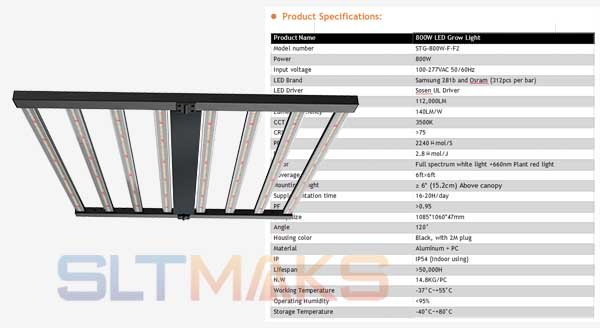
How Commercial Buyers Can Verify True Wattage (The Anti-Scam Checklist)
If you are a commercial grower, a greenhouse manager, or a vertical farm investor, you cannot afford to base your business calculations on marketing lies. Here is how to filter out trading companies and consumer-grade scammers instantly during your B2B sourcing process:
- Demand the "True Power Draw" (Wall Draw): Never look at the title of a listing or a catalog header. Ask the supplier for the exact wattage drawn from the socket at 120V/240V.
- Audit the LED Driver Brand & Model: The LED driver (power supply) is the heart of the fixture and it cannot lie. Ask for the specific model number from reputable industrial brands like Sosen. If a seller claims a fixture is "1000W" but it's equipped with a 120W driver, you know instantly that the fixture cannot output more than 120W.
Conclusion: Stop Buying Labels, Start Buying Performance
Commercial cultivation is a game of tight margins, electricity costs, and yield consistency. Relying on consumer-grade "marketing watts" is a liability your business cannot afford.
At our factory, we don't sell fictional numbers printed on cheap cardboard boxes. We engineer heavy-duty, high-PPE, transparently rated commercial lighting systems designed to lower your electricity bill and maximize your canopy's genetic potential.
Stop buying the hype on the label. Contact our engineering team today to get a real, data-driven light simulation for your commercial facility, along with true, verified engineering spec sheets.
FAQ
Q1: I am commercial growing in North America/Europe. Will your fixtures support our local commercial voltage grids?
- A: Absolutely. Unlike consumer-grade retail lights that usually only support standard residential 110W / 120V, our commercial-grade fixtures are engineered with heavy-duty industrial drivers. We offer options that seamlessly adapt to both low-voltage grids (100V - 277V) and high-voltage commercial grids (347V - 480V) common in large-scale facilities across the US, Canada, and the EU. Please specify your facility's voltage requirements when requesting a quote so we can configure the correct driver for you.
Q2: For bulk B2B orders, how do you ensure the large LED bars don't get damaged during ocean freight or air shipping?
- A: This is a major concern for international buyers. To eliminate shipping damage, our factory uses reinforced, customized industrial packaging. Every multi-bar fixture is shipped in a collapsed, flat-packed state wrapped in thick, anti-static EPE foam padding, housed inside a heavy-duty carton. For container-load or LCL shipments, we palletize and shrink-wrap the entire cargo to ensure zero movement during transit, significantly lowering your import risk.
Q3: Do your commercial grow lights carry the necessary certifications (DLC, ETL, CE, UKCA) required for commercial insurance and government rebates in my country?
- A: Yes. We understand that local compliance is non-negotiable for legal commercial cultivation facilities. Our core product lines carry major international compliance certifications, including UL8800 (for damp/wet environments), ETL, CE, UKCA and RoHS. Furthermore, many of our high-PPE fixtures are qualified for DLC (DesignLights Consortium), which is crucial if your facility plans to apply for local utility energy-rebate programs in North America.
Q4: As a factory, do you support custom private-labeling (OEM) and custom spectrums for specific crops, or do you only sell standard models?
- A: We are a direct, full-service manufacturing factory, meaning OEM and ODM customization is our primary strength. We don't just print your brand logo on the chassis. If your agronomy team requires a specialized spectrum ratio (e.g., higher Far-Red 730nm for flowering acceleration or specific UV channels for secondary metabolite boosting), we can engineer a custom PCB matrix for your bulk order. We can also customize bar lengths and folding mechanisms to perfectly fit your existing vertical racking systems.
Q5: If a driver or an LED bar fails mid-crop, how does your factory handle the B2B warranty internationally?
- A: We know that a dark canopy means lost revenue, and you cannot afford to ship broken lights back to Asia for repair. That is why we offer a 5-year comprehensive warranty backed by a Replacement First policy. Because we use top-tier global components like Inventronics and Sosen drivers, failures are extremely rare <0.2%. However, if a component does fail, you simply send our engineering team a quick photo/video of the issue with the serial number. We will air-express a brand-new replacement driver or LED bar directly to your facility immediately. If you are in the US or Canada, we can also fix it at your spot.