In our ongoing dialogues with facility owners and veteran growers, one question consistently surfaces, echoing a massive trend we see in global search data: "Is LED truly superior to HPS? Is now finally the time to retire my HPS systems and transition to LED?"
We fully understand this hesitation. For decades, HPS was the undisputed "Gold Standard" of reliability in horticulture. However, with the onset of the energy revolution and the rapid evolution of smart & precision agriculture, the traditional definition of "reliability" has been disrupted. We’ve written this professional technical analysis to cut through the noise and provide a transparent, data-driven comparison for those navigating this critical investment crossroads.
LED vs. HPS: Photonic Conversion Efficiency - The Physics of Modern Cultivation
In the transition from traditional high-pressure sodium (HPS) to light-emitting diodes (LED), the most fundamental shift is not just in the hardware, but in the efficiency of energy conversion. For a commercial-scale facility, electricity is one of the highest recurring costs. Understanding the physics of how a fixture converts a watt of power into usable photons is the first step in calculating long-term profitability.
PPE: The Metric of Professional Performance
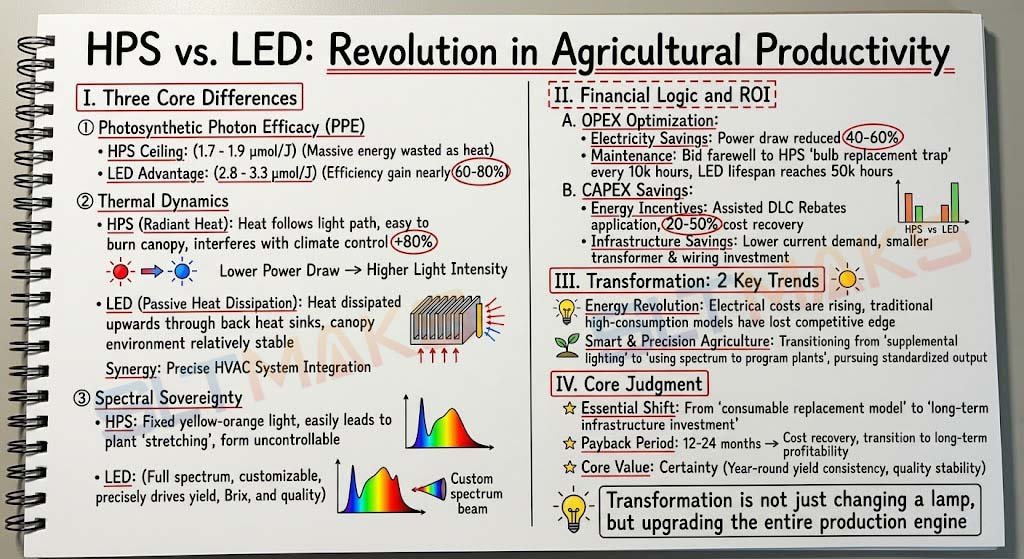
In the professional lighting industry, we move beyond "lumens" (which are designed for human vision) and focus on PPE (Photosynthetic Photon Efficacy). Measured in micromoles per joule (μmol/J), PPE tells a grower exactly how much "plant food" (photons) they are getting for every dollar spent on electricity.
- The HPS Ceiling: Traditional HPS technology has reached its physical plateau. Even the most advanced double-ended (DE) HPS fixtures typically peak at a PPE of 1.7 to 1.9 μmol/J. A significant portion of the energy is lost as infrared heat and omnidirectional light spray that requires inefficient reflectors.
- The LED Advantage: Modern professional-grade LED grow light systems, such as those engineered by SLTMAKS, routinely achieve PPE ratings of 2.8 to 3.3 μmol/J. This represents a nearly 60-80% increase in efficiency. For a commercial operator, this means you can either achieve the same light levels (PPFD) with half the power consumption or dramatically increase your light intensity without expanding your electrical infrastructure.
Targeted Delivery vs. Omnidirectional Loss
The physical form factor of the light source dictates how much energy actually reaches the plant canopy.
- HPS Reflector Inefficiency: An HPS bulb is a 360-degree point source. To get that light down to the crop, it must be bounced off a reflector. Every time a photon hits a reflective surface, some of its energy is absorbed and turned into heat. This "bouncing" process is inherently inefficient for systematic large-scale canopy coverage.
- LED Directional Precision: LEDs are directional light sources with integrated optics. You can choose precise beam angles (typically 120°) that deliver photons directly toward the foliage in a uniform footprint. This eliminates the need for bulky reflectors and ensures that the "Photon Flux" is concentrated exactly where photosynthesis occurs, minimizing light spill into aisles and walls.
Thermal Dynamics - Radiant Heat vs. Managed Dissipation
One of the most misunderstood differences between HPS and LED is how they handle heat. In a commercial-scale greenhouse, heat is not just a byproduct; it is a variable that can either stabilize or sabotage your entire climate control strategy.
The Infrared Shadow: The "HPS Burn"
HPS lamps function by creating a high-temperature plasma arc. A byproduct of this process is a massive amount of Infrared (IR) radiation.
- Radiant Heating of the Canopy: HPS heat is projected downward toward the plants along with the light. While this might be beneficial in cold-winter climates to help warm the greenhouse, it often results in excessive leaf temperatures. This "radiant shadow" can lead to increased transpiration rates, nutrient burn, and even pollen sterility in heat-sensitive crops like tomatoes or high-end orchids.
- The "Hanging Height" Restriction: To avoid leaf scorch, HPS fixtures must be hung several feet above the canopy. This increases the amount of wasted vertical space in your facility and limits your ability to use multi-tier racking systems.
Passive Cooling: The LED Advantage
Modern professional-grade LEDs are "cool" light sources. While they still generate heat, the physics of how that heat is managed is fundamentally different.
- Upward Dissipation: LEDs dissipate heat through heavy-duty aluminum heat sinks located on the back of the fixture. This heat rises away from the plants, maintaining a much more stable and cooler canopy environment.
- HVAC Synergy: Because the light source doesn't radiate heat downward, your facility-grown HVAC system (heating, ventilation, and air conditioning) can operate with far greater precision. You gain "Total Thermal Sovereignty" - the ability to control the room temperature via your climate computers, rather than having it dictated by your lighting system. This leads to significant reductions in cooling costs during summer months.
LED vs. HPS: Spectral Sovereignty - Fixed Output vs. Digital Precision
In precision agriculture, light is no longer just "illumination"; it is a digital instruction set for the plant’s DNA. The most profound difference between traditional HPS and modern LED systems lies in the ability to dictate the biological outcome of the crop through spectral engineering.
The Rigid Spectrum of HPS: A "One-Size-Fits-All" Legacy
HPS technology relies on the chemical properties of sodium vapor, which creates a fixed spectral output.
- Yellow-Orange Dominance: HPS spectrums are heavily concentrated in the yellow and orange wavebands (580nm to 620nm). While this is effective for driving general biomass, it is fundamentally incomplete. It lacks the critical Blue photons needed for structural strength and the Far-Red photons required for complex flowering responses.
- The "Stretch" Factor: Because HPS has a very low blue-to-red ratio, plants grown exclusively under HPS often exhibit "stretching" - long, weak stems and sparse internodal spacing. In a commercial-scale facility, this leads to inefficient space utilization and increased labor for plant support.
LED Spectral Engineering: Designing the Result
With professional-grade LED grow light systems, you can choose a spectrum tailored to your specific crop and growth stage. We call this "Spectral Sovereignty."
- Customized Recipes: LED arrays are built using specific diodes (e.g., 4000K 6500K White, 450nm Blue, 660nm Deep Red, 730nm Far-Red 395nm UV). This allows a grower to "program" the plant. Need a compact seedling? Increase the Blue. Want to accelerate flowering? Trigger the Emerson Effect with Far-Red.
- Uniform Quality: Because the spectrum is consistent across the entire fixture, every plant in the facility receives the same "instructions." This leads to a standardized harvest where fruit size, color, and chemical profiles (like Brix in tomatoes or terpenes in medicinal plants) are uniform, significantly increasing the market value of the crop.
LED vs.HPS: Financial Engineering - ROI
In the era of precision agriculture, a lighting system should be viewed as a productive asset rather than a mere expense. While the initial investment for LED is higher than HPS, a systematic financial analysis reveals that the long-term operational savings and yield increases create a far more compelling ROI.
OPEX: The Hidden Cost of "Reliability"
The perceived reliability of HPS often masks a high operational expenditure (OPEX) that erodes net profit over time.
- Energy Consumption: A professional-grade LED grow light fixture delivers the same amount of light as a 1000W DE HPS while consuming only 600W to 650W. In large-scale facilities, this 35-40% reduction in electricity usage directly impacts the bottom line from day one.
- The Maintenance Trap: HPS bulbs suffer from rapid "light decay," losing up to 10-15% of their intensity within the first year. To maintain yields, bulbs must be replaced every 8,000 to 10,000 hours. When you factor in the cost of bulbs and the labor required for a commercial-scale replacement, the "cheap" HPS becomes remarkably expensive.
CAPEX: Strategic Investment vs. Initial Cost
While the capital expenditure for LED is higher, the modern energy revolution has introduced mechanisms to offset this initial hurdle.
- Utility Rebates and Incentives: Many regions now offer significant financial incentives for transitioning to energy-efficient technology. By choosing DLC-qualified fixtures from providers like SLTMAKS, facilities can often recover 20-50% of their CAPEX through utility rebates.
- Infrastructure Savings: Because LEDs have a lower power draw, new facilities can save significantly on electrical infrastructure - smaller transformers, thinner wiring, and reduced panel capacity - offsetting the higher cost of the fixtures themselves.
The ROI Timeline: Turning Photons into Profit
In a technological cultivation environment, the payback period for switching to LED typically falls between 12 and 24 months.
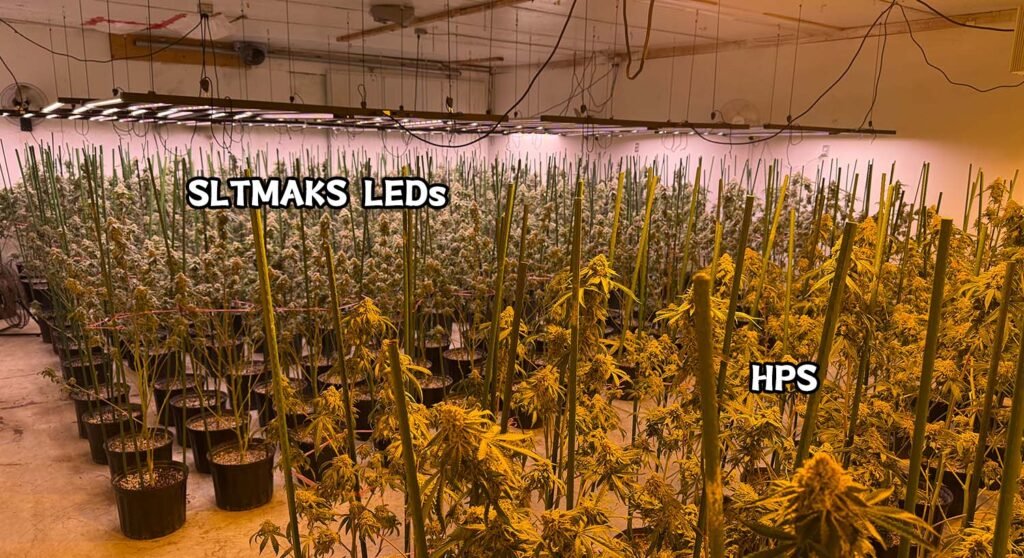
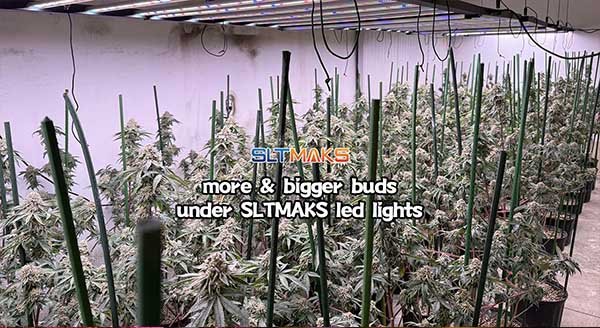
- Yield Gains: Beyond energy savings, the spectral precision of LED often leads to a 10-15% increase in total yield and higher market quality (better color, higher Brix). When these gains are factored in, the ROI accelerates significantly.
- Long-Term Security: With a lifespan of 50,000 to 100,000 hours, an LED system provides a longer predictable performance. It is a transition from the "replenishment model" of HPS to the "infrastructure model" of LED.
Conclusion: Embracing the LED
The transition from HPS to LED is far more than a simple hardware replacement; it is an entry into the era of data-driven agriculture. While HPS served the industry faithfully during the analog era, the modern energy revolution and the demands of precision farming require a more sophisticated toolset.
By choosing to transition, you are moving from a system of "fixed limitations" to one of "limitless potential." You are gaining total control over your thermal environment, your spectral output, and most importantly, your long-term operational profitability.
At SLTMAKS, with our 16-year heritage in lighting innovation, we don't just provide fixtures; we provide the technological foundation for your success. The question is no longer whether LED is ready for your facility—it is whether your facility is ready for the competitive advantages that only professional LED integration can provide.