
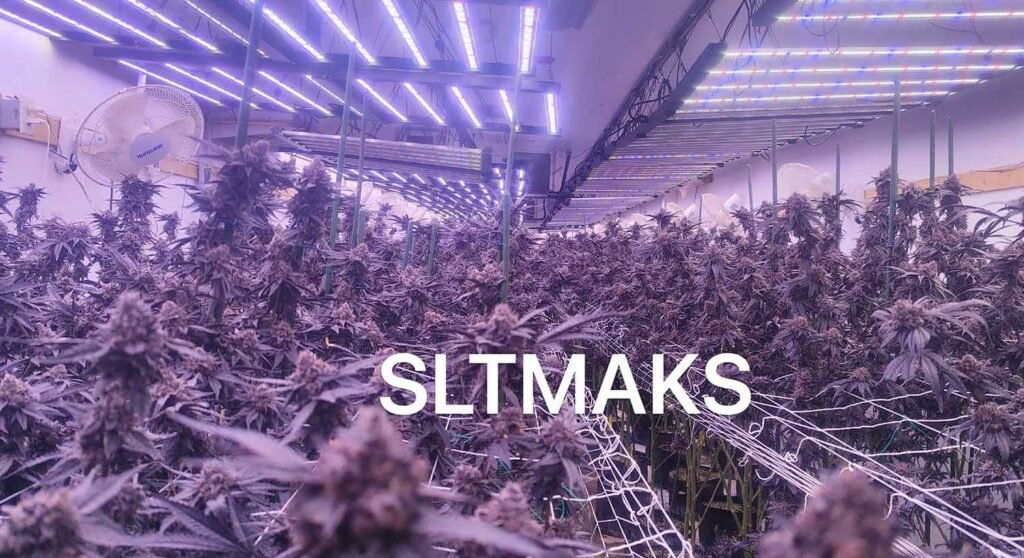
In the competitive landscape of 2026, the difference between a high-margin facility and one struggling to break even isn't just the strain - it's the Photosynthetic Photon Efficacy (PPE) of the hardware. Many growers wait for a fixture to "burn out" before replacing it. In commercial growing, this is a million-dollar misconception.
1: Asset Assessment: Redefining the "Commercial Lifespan" of LEDs
The 24-Month "Profitability Watershed"
On a spec sheet, you'll frequently see Lifespan > 50,000 hours. In theory, this suggests the fixture can maintain 90% of its brightness for up to 11 years (under a 12/12 cycle). However, these figures are derived from laboratory conditions: constant temperatures, zero dust, and stabilized voltage.
In a real-world grow room, high humidity, volatile nutrients, dust accumulation, and daily thermal cycling cause micro-cracks in the diode's silicone resin. According to IES LM-80 reports, actual degradation in industrial environments is 40%–60% faster than in the lab. This means that by the 24-to-36-month mark, the actual PPFD of many mid-tier fixtures has already plummeted below the "profitability baseline" for high-yield production.
Spectral Drift: The Invisible Culprit Behind "Thin" Flowers
This isn't just a drop in intensity; it is a fundamental shift in spectral quality. As phosphors age, blue light shifts toward longer wavelengths, and the peaks for red light - specifically the critical 660nm Deep Red - begin to flatten out.
- The Consequence: Your plants stop receiving the correct "biological signals." A decline in the red light ratio directly slows the photosynthetic rate, resulting in airy, loose buds and significantly lower terpene content.
- The Commercial Cost: Your harvest can easily be downgraded from "A-Grade Top Shelf" to "B-Grade Wholesale," leading to a potential revenue loss of $200 – $500 per pound.
- Thermal Resistance Creep: As internal thermal paste dries out, diode junction temperatures rise. This creates a "death spiral": higher heat leads to faster decay, which leads to even less light output for the same electricity cost.
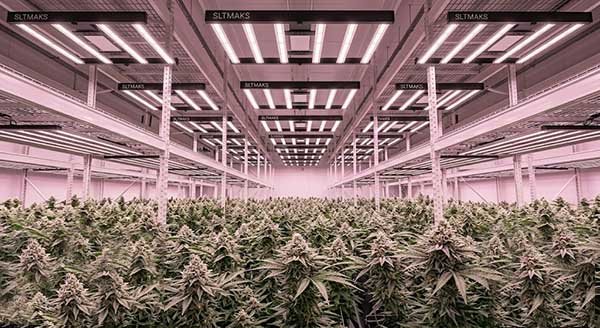
2: The ROI Gap - Why "Saving Money" is Costing You Cash
In the commercial world, an aging light isn't a "paid-off asset" - it's an Efficiency Leak. If you are running 2-3 year old LEDs with an efficacy of 2.4 μmol/J, while the 2026 industrial standard has reached 3.0-3.2 μmol/J, you are facing a massive Opportunity Cost.
The Power Leak: Paying for Heat, Not Photons
Many growers only look at the wattage, thinking "600W is 600W." But in 2026, the math has changed.
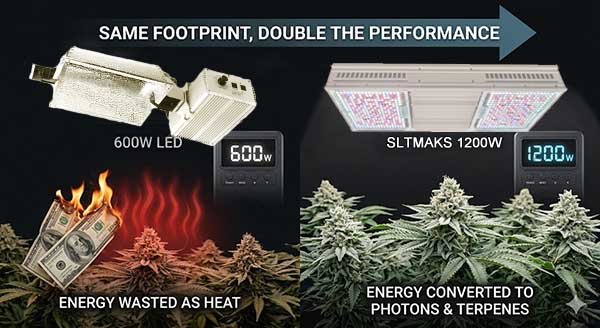
- Photon Conversion Efficiency: A 2.4 μmol/J fixture converts a significant portion of every dollar spent on electricity into Radiant Heat instead of light. To get the same 1920 μmol/s output as a modern 600W fixture (3.2 μmol/J), your old system would need to pull 800W from the wall.
- The Double Penalty: You aren't just paying 25-33% more on your lighting bill. That extra 200W of wasted energy is released as heat, forcing your HVAC (Air Conditioning) to work harder. For every $1,000 extra you spend on old lighting, you are likely spending another $300-$400 just to cool the heat that light produced.
The Yield Deficit: The Difference Between "Weight" and "Value"
A 15% drop in PPFD (Photosynthetic Photon Flux Density) doesn't just mean a 15% smaller harvest - it often means a 40% drop in Top-Shelf yield.
- Threshold Lighting: Commercial crops have a "Sweet Spot" for light intensity. Once your PPFD drops below a certain threshold (e.g., 900 μmol/㎡/s for high-performance flower), the plant fails to develop the internal density required for premium pricing.
- The "Larf" Factor: In a 100-light facility, that 15% "invisible" light loss turns your tight, resinous top buds into "Larf" - loose, airy buds that sell for 50% less.
- The $100,000 Math: On a 100-light scale, producing just 0.2 lb less per light (due to decreased density) at a market price of $1,000/lb equals $20,000 lost per harvest. Over 4-5 cycles a year, you are literally throwing $100,000 into the trash.
3: The HPS/MH Ultimatum - The Final Exit
In 2026, continuing to run HPS (High-Pressure Sodium) or MH (Metal Halide) is no longer a "traditional choice" - it is a competitive disadvantage. The gap between legacy gas-discharge lighting and SLTMAKS Industrial LED standards has become an abyss.
The HVAC Burden: Stop Paying to Fight Your Own Lights
HPS technology is fundamentally inefficient; it is essentially a heater that produces light as a byproduct.
- The 60% Thermal Trap: HPS systems convert over 60% of their energy into infrared heat. This radiant heat hits the leaf surface directly, raising the leaf temperature (VPD stress) and forcing your HVAC system into a constant battle.
- Quality Caps: The lack of a blue-spectrum peak in HPS makes it impossible to compete in the 2026 "A-Grade" market where bag appeal and high-crystal density are mandatory.
The Quality Cap: Why HPS Can't Reach "A-Grade" Status in 2026
The 2026 consumer market demands high terpene profiles, extreme trichome density, and "bag appeal." The static, yellow-heavy spectrum of HPS simply cannot deliver these results.
- The Missing Blue Peak: HPS is notoriously deficient in blue light, which is crucial for controlling plant height and stimulating secondary metabolites (THC/CBD/Terpenes). Without it, plants become "leggy," and the chemical potency hits a hard ceiling.
- Photo-Degradation: The intense radiant heat from HPS often volatilizes terpenes before you even harvest. SLTMAKS LEDs provide a "cool" high-intensity light that preserves these delicate aromatic compounds, resulting in a product that smells louder and looks frostier.
The Maintenance Death Spiral: The Hidden Costs of Legacy Tech
- The Labor Trap: HPS bulbs must be replaced every 2-3 cycles to maintain even a semblance of efficiency. In a commercial facility, the labor cost of changing hundreds of bulbs, coupled with the rising price of legacy hardware, creates a "Maintenance Death Spiral."
- Reliability Risk: Old ballasts are prone to failure and pose a significantly higher fire risk than modern, IP65-rated LED drivers. In 2026, insurance companies are starting to favor LED-equipped facilities with lower premiums due to reduced fire hazards.
4: The 2026 Industrial Standard - Why SLTMAKS?
When you retrofit a commercial facility, you aren't just buying lights; you are choosing a partner for the next peak performance window.
- Component Integrity: We utilize Samsung's latest diode generations and SOSEN (Publicly Listed) 2026-spec drivers. This combination is engineered specifically to resist the moisture and thermal stress of high-density grows.
- Future-Proof Control: Our systems integrate with AI environment controllers to sync lighting with VPD (Vapor Pressure Deficit), ensuring your plants are never over-stressed or under-fed.
Conclusion: Leading the 2026 Efficiency Race
In the 2026 commercial landscape, supplemental lighting has evolved far beyond a simple farming tool; it is now the primary engine for ROI acceleration. The transition from "legacy survival" to "market leadership" happens the moment you stop viewing high-performance LEDs as a capital expense and start seeing them as a high-yield production asset.
Whether you are retrofitting a 24-month-old LED facility or finally retiring your HPS fleet, the goal remains the same: Maximizing micro-mols per dollar. At SLTMAKS, we don't just manufacture lights; we engineer the competitive edge that keeps your facility profitable for years to come.
FAQ
Q1. Can I use my existing HPS wiring and breakers for a 1200W LED retrofit?
- A: Yes, you can replace it with our 1200W grow light module. It's designed for 1:1 HPS replacement with existing wiring. You can check this link to the model 1200W model
Q2. How does the 2026 SLTMAKS spectrum affect "Stretch" during the first two weeks of flower?
- A: Our optimized blue-to-red ratio is designed to minimize unwanted internodal stretching. By providing higher blue intensity during the transition, we help growers maintain a flatter, more manageable canopy without chemical growth regulators.
Q3. Does you offer Master Controller integration for sunset/sunrise simulation?
- A: Yes. We have smart controller to set timing and brightness, stimulate sunrise and sunset. Controller sold separately. Please feel free to contact us for product details.
Q4. I'm running HPS. Will switching to LED change my plants' nutrient and water uptake?
- A: Absolutely. Because LEDs produce less radiant heat, leaf transpiration slows down. You may need to increase your room temperature slightly and adjust your EC levels to compensate for the different metabolic rate compared to HPS.
Q5: Are SLTMAKS fixtures eligible for energy utility rebates in America?
- A: Yes, Most of our commercial models are DLC Premium listed, which is the gold standard for utility rebate eligibility. We provide the necessary DLC QPL documentation for your application.
Q6: Can I customize the spectrum for specific cultivars (e.g., high THC vs. high CBD)?
- A: Yes. For large-scale commercial orders, we offers OEM spectrum customization to emphasize specific wavelengths (like UV or Far-Red) tailored to your specific genetic catalog.