
Quick View:
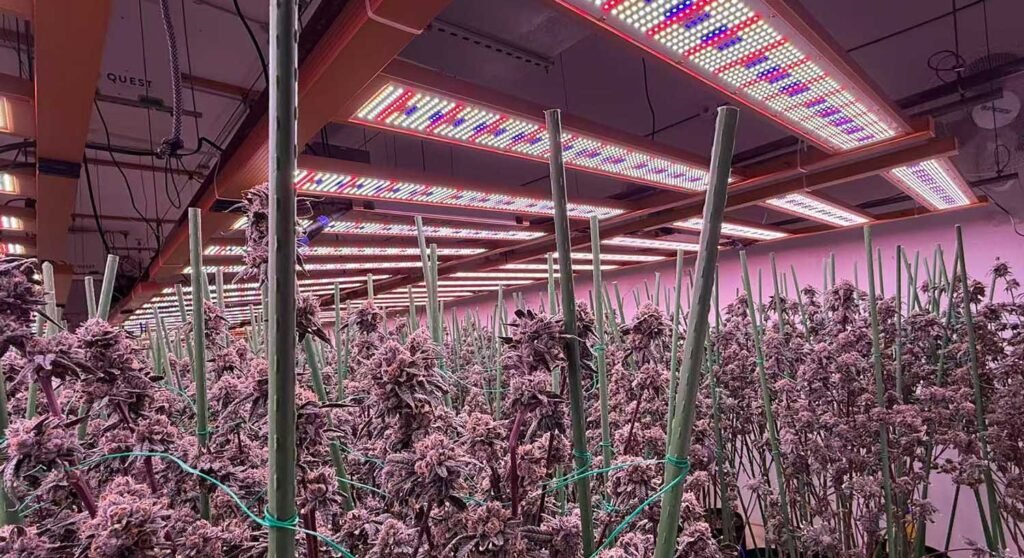
- Do grow lights have UV? Most generic full-spectrum LED grow lights usually do not contain UV, because the protective phosphorus coating naturally filters it out. True UV must be added via dedicated, specialized UV LED chips.
- Do plants need UV light? Can it improve yields? It is not required for basic survival, but plants highly benefit from it. UV triggers a "natural defense mechanism" that spikes phytochemical yield (flavors, aromas, brix, and antioxidants), while IR drives physical biomass.
- Can UV replace sunlight? No, it cannot replace the total energy of the sun, but it perfectly clones the sun's natural "stress signals" that indoor plants crave.
- Operational Control Rule: Never run UV channels continuously. UV should be deployed dynamically (e.g., 1–3 hours during peak photoperiods) to prevent phototoxicity and leaf scorching.
Understanding UV in Horticulture: What It Is and Why Indoor Plants Need It
When growers transition to indoor CEA (Controlled Environment Agriculture) facilities, the most common hardware question they ask is: "Do grow lights have UV?" The honest engineering answer is: most standard LED grow lights on the market deliver zero UV energy. To better understand the answer, we must first look at how ultraviolet light operates as a biological control signal in modern horticulture.
The LED Packaging Phosphor Wall (Why Standard Lights Lack UV)
The honest engineering reality is that most standard commercial LED grow lights deliver zero UV energy.
Commercial white LEDs are created using gallium nitride (GaN) blue chips (450nm) encapsulated in a silicone matrix mixed with rare-earth phosphors. This phosphor layer acts as a physical barrier that absorbs and converts high-energy photons into yellow/green light to create a balanced white appearance. In this chemical conversion process, any trace emission below 400nm is entirely blocked.
True horticulturally effective UV spectral delivery requires the addition of discrete, dedicated monochromatic UV semiconductor dies. If you do not see isolated, independent dark-purple or clear glass-capped chips on the PCB board, your lighting system has no UV capability.
Signal vs. Survival: Do Plants Actually Need UV Light?
Strictly speaking, plants can complete their entire lifecycle under standard red and blue light without ever seeing a single UV photon. They can survive without it, but they cannot thrive to their full genetic potential without it.
Think of UV light as the "exercise and fitness training" for plants. In a closed indoor grow room, plants are completely protected from wind, rain, and harsh environmental variables. They become soft, tender, and pampered. UV light introduces a controlled, natural stress factor that activates specific photoreceptors inside the plant cells. This forces the plant to adapt, make itself stronger, and unlock premium characteristics like intense color, deep flavors, and dense aromas that remain dormant in a standard greenhouse environment.
Commercial Value: Can UV and Infrared (IR) Interplay Truly Improve Yields?
Many growers struggle with the dilemma: "Are UV lights really beneficial for indoor plant growth, or could they harm them?" and "Can infrared and UV grow lights improve indoor gardening yields?"
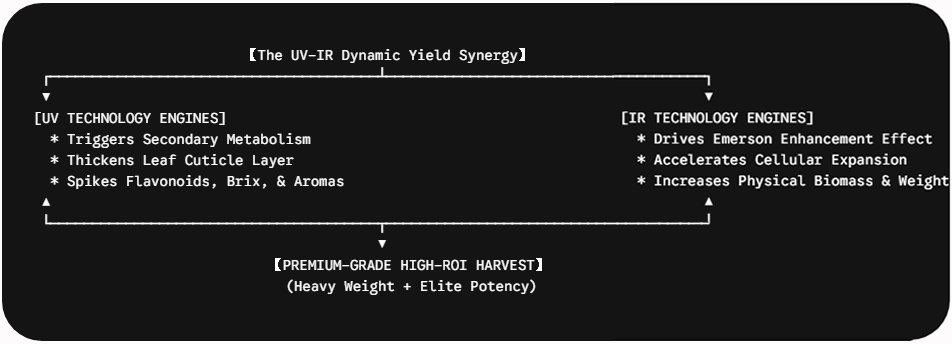
To unlock maximum commercial return on investment (ROI), we must define "yield" via a two-tier matrix: Biomass Yield (physical wet/dry weight) and Phytochemical Yield (potency, brix, terpene accumulation, and essential compound concentration). UV and Infrared (IR) lights sit at the two extreme ends of the spectrum, and they work like a perfectly orchestrated team to drive both metrics.
UV Technology as the Potency and Quality Concentrator
When UV light hits the canopy, it triggers a defensive metabolic response. The plant feels a "sunburn risk" and immediately upregulates the synthesis of secondary metabolites - such as flavonoids, anthocyanins, polyphenols, and essential oils - to act as its natural protective shield.
- Flavor & Brix Boost: This biochemical shift directly drives up the sugar concentrations (Brix index) in fruiting crops like strawberries and vine tomatoes, eliminating the flat, watery taste common in standard hydroponic produce.
- Structural Cuticle Armor: UV photons induce cell wall lignification, making the outer leaf skin (the cuticle) thicker and physically much tougher. This significantly reduces the germination success of fungal spores (like Powdery Mildew) and prevents chewing pests (like spider mites and thrips) from easily puncturing and feeding on the leaves, slashing your crop loss risks.
IR/Far-Red Technology as the Physical Biomass Motor
While UV light focuses on quality, defense, and potency, Infrared (specifically Far-Red light, 700-800nm, usually use 730nm) operates as the size and speed engine.
- The Emerson Enhancement Effect: When standard Deep Red light (660nm) and Far-Red/Infrared light (730nm) are delivered to the canopy simultaneously, they drive a massive quantum synergy known as the Emerson Effect. This combination hyper-drives Photosystem I and II simultaneously, speeding up the entire photosynthetic conveyor belt.
- The Combined Financial Result: The IR channel forces cellular expansion, broadens leaf surface areas to capture more photons, and accelerates carbohydrate allocation into the fruit sites. Operating integrated UV and IR channels creates a crop that is not only physically larger due to IR, but significantly more dense, flavorful, and premium-priced per gram due to UV.
Best Practices: How Long to Run UV Lights per Day Safely?
Because UV light carries highly intensive energy, growers are understandably anxious about the operational details: "how long to leave uv light on plants" and "how long should I run a UV grow light per day to avoid stressing and scorching my plants?"
If an operator runs an un-throttled, intensive UV channel for a continuous 12 to 18 hours straight, it will overwhelm the plant's internal cellular repair mechanisms (DNA photolyase pathways), resulting in leaf chlorosis (bleaching), tissue necrosis, and severe growth stunting. To prevent phototoxicity, commercial facility engineering mandates a strict time-staged scheduling protocol:
The Noon-Simulation Scheduling Protocol
The Baseline PAR Array: Runs continuously for the full daylength (12 to 18 hours per day depending on crop type and vegetative/flowering schedule).
The UV Channel Injection: Treat the UV channel like the intense, scorching midday sun. Only activate the UV channel for 1 to 3 hours maximum per day, precisely scheduled in the exact middle of your main photoperiod cycle. This concentrated pulse delivers the necessary stress-conditioning signal to the crop's DNA without causing long-term cellular damage.
Grower's Field Notes: Separating Your Light Channels for Success
When selecting a fixture, we strongly advise against buying a basic "single-channel" grow light where the UV diodes are hard-wired onto the exact same circuit as your main white and red chips. If everything turns on and off at the same time, you lose the ability to fine-tune your environment.
This separation is absolutely vital because seedlings, freshly rooted clones, and early vegetative sprouts have virtually zero tolerance for UV radiation. Their tender tissues lack any protective exterior armor, and exposing them to UV too early will cause instant leaf scorch and stunt their growth permanently. The UV spectrum must remain completely locked away until your plants establish robust structural maturity.
【Our Multi-Channel Advantage】
[2-CHANNEL FIXTURE] ──► Channel 1: Main Spectrum (White/Red)
└──► Channel 2: Dynamic UV Control (Independent)
[3-CHANNEL FIXTURE] ──► Channel 1: Main Spectrum
├──► Channel 2: UV Boost (Quality & Aroma)
└──► Channel 3: IR/Far-Red (Biomass & Weight)
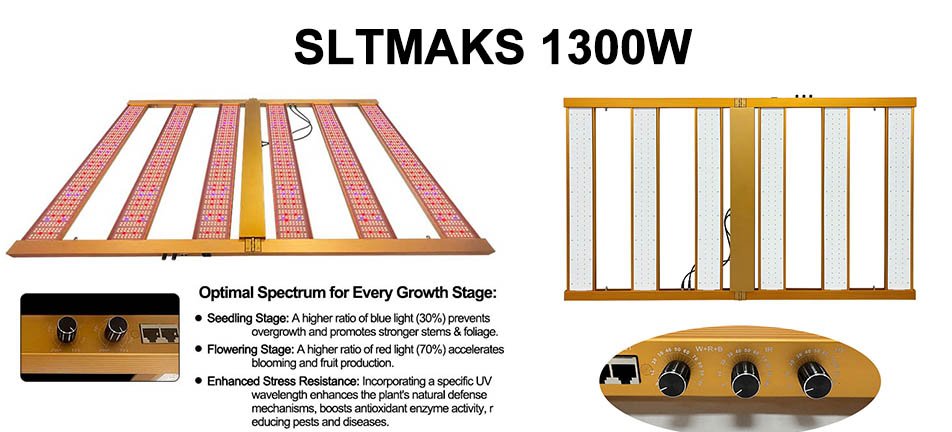
To give you complete command over your canopy, our premium fixtures are engineered with advanced 2-channel and 3-channel systems, allowing you to control UV and IR completely independently.
- With our 2-channel setups, you can run your main full spectrum all day while keeping the UV channel safely turned off until the exact hour your plants are ready for it.
- With our 3-channel flagships, you gain the ultimate freedom: you can trigger the IR channel early on to expand leaf surface area, keep the main spectrum running smoothly, and independently flash the UV channel for just 1–3 hours during peak times to spike aromas without any risk of burning your crop.
Professional B2B FAQ: Answering Core Operational Questions
Can UV grow lamps replace natural sunlight entirely?
The short answer is both No and Yes. They cannot replace the sun’s horsepower, but they perfectly replace the sun's biological instructions. By pairing a high-biomass Full Spectrum + IR engine with a dynamic, standalone UV control channel, you achieve the holy grail of controlled environment agriculture (CEA): The massive volumetric yields of a high-tech indoor factory, combined with the premium, top-shelf flavor, aroma, and medicine of pristine, sun-grown wild nature. To understand why, we must divide natural sunlight into two distinct roles: The Energy Engine (which drives plant size and weight) and The Information Programmer (which drives plant quality, flavor, and strength).
An artificial UV lamp cannot replace the sun's sheer energy volume, but it 100% perfectly clones the sun's critical environmental signals that dictate premium crop quality.
The "NO" Side: UV is a Signal, Not a Primary Energy Source
If you try to grow a plant under only UV lamps, it will die.
- The Physics Reality: The sun is a massive, brute-force nuclear fusion reactor delivering a colossal volume of raw energy (measured in kilowatts per square meter) across the visible spectrum (400-70nm). Plants use this standard visible light as their primary fuel to create carbohydrates, expand leaves, and build their physical skeleton through photosynthesis.
- The UV Role: UV light represents only a tiny fraction of total sunlight. It carries very high quantum energy but is not the "food" the plant eats to get bigger. Therefore, UV lamps cannot replace the sun's raw capacity to grow massive biomass; they must always work in tandem with a high-powered, full-spectrum LED base that handles the heavy lifting of daily photosynthesis.
The "YES" Side: Clones the "Sun's Stress" to Eliminate Greenhouse Syndrome
Where UV grow lamps do completely replace the sun is in the department of quality control, chemical potency, and structural defense.
- The Tragic "Greenhouse Syndrome": When plants are grown indoors under standard, protected LEDs, they live a coddled life. Without the harsh elements of natural sunlight, they suffer from what botanists call "Greenhouse Syndrome." They grow fast but soft, watery, and structurally weak. Because they never face environmental stress, their genetic switches for producing flavors, vibrant colors, and rich medicinal compounds remain turned off. Their taste becomes flat and uninspired.
- The Evolutionary Trigger: For millions of years, plants evolved in the wild under the sun's blistering UV rays. They developed an ancestral survival mechanism: when UV hits their leaves, it triggers an internal "sunburn alarm." To protect their cells, plants immediately start producing complex secondary metabolites—flavonoids, anthocyanins, brix (sugars), and pungent essential oils—which act as a natural organic sunscreen.
- The Premium Transformation: By injecting precision artificial UV light into an indoor facility, you trick the plant's DNA into thinking it is fighting for survival in a rich, sun-drenched outdoor field. The plant response is magnificent: it thickens its leaves, tightens its structural node spacing, and packs its cells with dense antioxidants, crystallization, and intense aromatic terpenes.
The Grower’s Choice: Finding Your Ideal Spectral Configuration
To build a truly successful indoor facility, choosing a light isn't just about grabbing the highest wattage -it's about understanding how different lighting setups change your daily running style, protect your crops, and ultimately dictate the market value of your harvest.
Let's look at how adding specialized channels like UV and IR shifts you away from low-margin farming and into high-value cultivation:
| What You Care About | Generic Single-Channel Light | Our Advanced 2-Channel System | Our Preminum 3-Channel System |
| Spectral Flexibility | [Zero Adjustment]. UV/IR diodes (if any) are hard-wired to the main loop, making separate shutoff impossible. | [Highly Flexible]. Main white PAR spectrum runs smoothly all day, while the UV channel activates independently. | [Ultimate Freedom]. Main white PAR, UV potency channel, and IR biomass engine all operate under separate controls. |
| Seedling Safety Metric | [High Phototoxicity Risk]. Turning on the fixture activates UV automatically, easily scorching fragile young leaves. | [100% Safe Safeguard]. Completely locks down the UV channel (0W) early on to provide gentle protection for seedlings. | [100% Safe + Root Boost]. Shuts off UV to protect soft tissue while running low IR to stimulate root development. |
| Natural Plant Defense | [Baseline Immunity]. Leaves remain soft and pampered without UV stimulation, making them highly vulnerable to powdery mildew. | [Active Fortification]. Activating UV later in the cycle thickens the waxy cuticle armor, resisting pests and molds. | [Elite Immunological Armor]. Timed UV pulses build an impenetrable cell-wall barrier against environmental pathogenetic risks. |
| Daily Operation Lifestyle | [Rigid & Basic]. Limited to standard on/off timers; impossible to alter spectral recipes for different growth phases. | [Precision Deployment]. Once the crop achieves physical maturity, simply toggle Channel 2 to inject quality-boosting signals. | [Masterful Crop Steering]. Run IR early to stretch leaf area, deliver rich PAR mid-cycle, and blast UV late to maximize terpenes. |
| Crop Market Value | [Low-Margin Commodity]. No edge over generic commercial greenhouse produce; yields flat profiles that sell at low market prices. | [Premium Grade]. Significantly increases Brix index (sugars), creates dense fruit, and commands higher wholesale pricing. | [Top-Shelf Luxury Value]. The absolute holy grail of growing. Perfect synergy of heavy biomass (IR) and extreme terpene saturation (UV). |
Conclusion:
Deploying spectrum extremes - the strategic balance of UV and IR photons - is the ultimate boundary separating basic greenhouse automation from high-margin molecular crop engineering. Moving past the limitations of generic lighting allows commercial facilities to control not just the volume of their harvest, but its exact chemical composition, flavor, and financial market valuation.
FAQ
Q1: When I run the independent UV or IR channels, do I need to adjust the hanging height or distance of the fixtures to avoid hot spots?
- A: No, you do not need to constantly raise or lower the lights if your fixture features a properly engineered multi-channel layout. However, you must pay attention to minimum safe canopy distance. Because UV photons carry high quantum energy and IR photons drive localized cell expansion, hanging the lights too close (e.g., under 12 inches / 30 cm) can cause localized spectral "hot spots" before the different wavelengths have space to blend in the air.
- The Rule of Thumb: Maintain a steady hanging height of 18 to 24 inches (45–60 cm) from the top of the plant canopy.
- The Multi-Channel Fix: Instead of moving the heavy physical fixture up and down, you simply use our independent dimming controls to lower the intensity percentage of the UV or IR channels during early growth stages, and ramp the power up as the canopy matures.
Q2: Ultraviolet light is invisible or barely visible to the human eye. How can a grower tell if the UV chips are actually working or if their intensity has degraded over time?
- A: This is a major blindspot in indoor cultivation. Because UV light sits on the edge of human vision, a UV diode might look like a very dim, faint glow, making it impossible to judge its actual output power with the naked eye. However, you don't always need a million-dollar lab to check them.
- The Quickest 1-Second Smartphone Hack (Daily Check): The easiest, free way to check your UV chips is to simply point your smartphone camera at the fixture. While human eyes can't register the wavelengths, most smartphone camera sensors (CMOS) can capture them. Through your phone screen, you will instantly see a bright, distinct neon-purple or bluish glow coming from the dedicated UV chips. If it shows up bright on your screen, your UV channel is running! (Note: Please do not stare at the lights directly through your bare eyes while doing this).
- The Pro Spec Degradation Test (Long-Term Tracking): While the smartphone camera tricks tell you if the light is ON, it cannot tell you if the chips are losing power over years. To track long-term spectral decay, commercial facilities should use a specialized extended-spectrum spectrometer (measuring the sub-400nm band) once every few harvests. Our multi-channel fixtures utilize top-tier, industrial-grade UV semiconductor dies engineered with ultra-slow degradation curves, guaranteeing that your "quality-boosting signature" stays calibrated for years, unlike cheap single-channel lights that burn out their UV power within 6 months.
Q3: Is UV light dangerous for humans working in the grow room? What safety protocols should my facility team follow?
- A: Yes, high-energy UV radiation makes no exception between plant tissue and human tissue. Continuous exposure to active UV wavelengths can cause severe skin irritation (similar to sunburn) and photokeratitis (corneal burns to the eyes).
- The Single-Channel Danger: In a basic single-channel setup, workers are forced to stand under blasting UV rays whenever they prune or check the crops, posing a massive labor compliance risk.
- Our People-First Safety Fix: Thanks to our 2-channel and 3-channel isolated circuitry, protecting your team is incredibly simple. When your staff needs to enter the facility for daily crop maintenance, scouting, or defoliation, you can instantly click off the UV channel via the control app or master console while keeping the main full-spectrum white lights running perfectly. Your workers can complete their duties in a 100% safe, high-visibility environment, and you can flick the UV power back on the moment they exit the room.