
Introduction: The Costly Mistake in Commercial Growing
Walk into many commercial greenhouses or indoor vertical farms, and you’ll see crops bathed in powerful, high-tech artificial light. Growers naturally want bigger yields, faster growth, and sweeter fruits. However, many growers face a frustrating bottleneck: skyrocketing energy bills but stagnant harvest quality.
Why? Because they confuse "feeding the plants" with "setting the plants' alarm clock."
In plant photobiology, there is a fundamental dividing line between Photosynthetic Lighting and Photoperiodic Lighting. Understanding this distinction is the secret to cutting energy waste by up to 30% while unlocking the full genetic potential of your crops.
The Core Difference - "Eating to Full" vs. "Waking Up on Time"
To master commercial plant lighting, you must look at photons through two entirely different lenses: energy and signals.
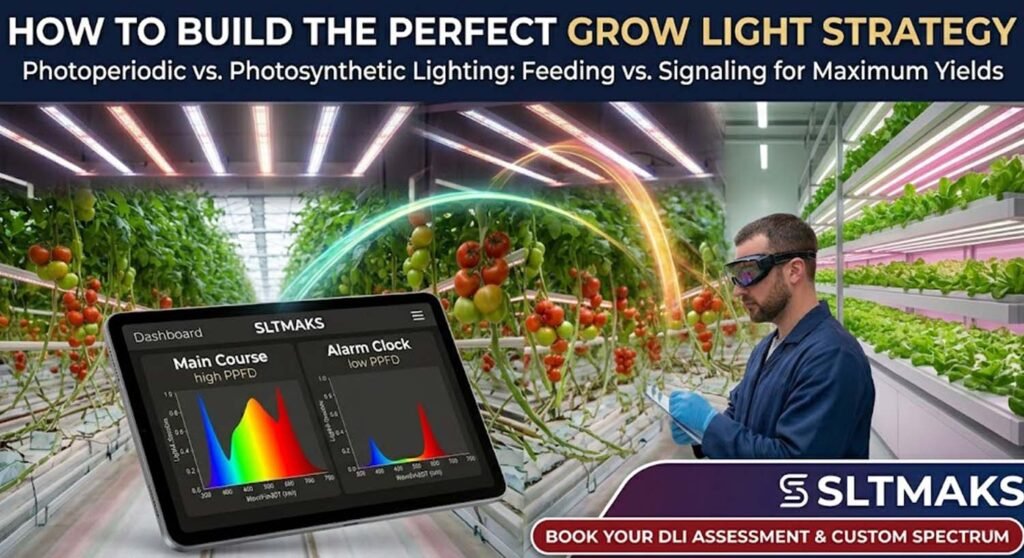
| PHOTOSYNTHETIC LIGHTING (The "Main Course") * Purpose: Drive Biomass & Sugar * Power: Ultra-High Intensity * Metric: High PPFD (150-1000+) | PHOTOPERIODIC LIGHTING (The "Alarm Clock") * Purpose: Control Phenology * Power: Ultra-Low Intensity * Metric: Low PPFD (2-15) |
🌿 Photosynthetic Lighting: Driving the Biomass Engine
Think of photosynthetic lighting as the "main course" for your plants. Its sole purpose is to provide the raw photon energy required for photosynthesis - turning water and carbon dioxide into sugars, stems, and fruits.
- The Key Metric: Photosynthetic Photon Flux Density (PPFD).
- Intensity: Extremely high. Crops typically require anywhere from 150 μmol/(㎡·s) (for leafy greens) to over 1000 μmol/(㎡·s) (for flowering cannabis).
- The Spectrum: Broad or full spectrum, heavily relying on Deep Red (660nm) and Royal Blue (450nm) to drive maximum photosynthetic efficiency.
⏰ Photoperiodic Lighting: Triggering the Biological Clock
Photoperiodic lighting does not feed the plant; it communicates with it. Plants track the changing seasons by measuring the continuous duration of darkness. By applying micro-doses of specific light wavelengths, growers can fool a plant's internal clock - either delaying flowering, inducing early blooming, or preventing dormancy.
- The Key Metric: Photoperiod Duration and Spectrum Ratio.
- Intensity: Incredibly low. A mere 2 ~ 15 μmol/(㎡·s) is enough. It's not enough to grow the plant, but it’s more than enough for the plant's photoreceptors (phytochromes) to sense "daytime."
- The Spectrum: Precision-engineered signals, highly dependent on the ratio between Deep Red (660nm) and Far-Red (730nm).
Deep Dive - Tailored Lighting Blueprints for High-Value Crops
Different crops require different strategies. Let’s look at how elite growers combine these two lighting methods for four industry-defining crops:
Cannabis: High-Intensity Demands & Zero-Tolerance Dark Periods
Cannabis is a classic short-day crop, requiring a strict shift in its life cycle.
- Vegetative Stage: Requires high photosynthetic light (PPFD500-800) for 18-24 hours a day to build a strong canopy without flowering.
- Flowering Stage: Switched to a strict 12-hour light / 12-hour dark cycle.
- The Pro Strategy: During flowering, cannabis demands massive PPFD (800-1600). However, the night cycle must be absolute darkness. Even minor light leaks or poorly timed photoperiodic signals can trigger hermaphroditism or halt blooming entirely. Advanced growers use a burst of Far-Red (730nm) at the "End-of-Day" to rapidly transition phytochromes, effectively shortening the overall flowering cycle by days.
Tomatoes: Defeating the Canopy Shadow with Inter-lighting
Tomatoes are photoperiod-insensitive but require massive Daily Light Integrals (DLI).
- The Challenge: Tomatoes grow into tall, dense vine structures. Traditional top-lighting cannot penetrate the thick upper leaves, leaving middle and lower leaves starved of photosynthetic energy.
- The Pro Strategy: Combining high-power LED top-lighting with double-sided LED Inter-lighting modules. By placing low-heat, high-efficiency photosynthetic light strips directly within the canopy rows, commercial greenhouses boost fruit weight and sugar content by 20-30% without burning the leaves.
Strawberries: Precision Spectrum for Premium Flavor
Indoor vertical farming of strawberries requires strict control over both plant architecture and fruit quality.
- The Challenge: Preventing long, weak leaf petioles (stretching) while maximizing flower bud differentiation.
- The Pro Strategy: Cultivators use modest PPFD (200-350) but dynamically shift the spectrum. Increasing the Blue light (450nm) ratio during maturation prevents stretching, while adding precise doses of UV-A and Far-Red enhances accumulation of anthocyanins and soluble solids - making the strawberries redder, sweeter, and far more aromatic.
Leafy Greens & Lettuce: Maximizing Efficacy & Pre-Harvest Treatment
For lettuce, the goal is fast cycles, crisp texture, and zero "bolting" (premature flowering, which makes the leaves bitter).
- The Strategy: Keep photoperiods long (16-18 hours) with moderate PPFD (150-250) but avoid heavy Far-Red spectrums that trigger flowering signals.
- The Pro Strategy: Implementing a "Pre-Harvest Treatment" 3 to 5 days before harvest. By turning off the red spectrum and running pure Blue/UV-A light, growers trigger a mild stress response in the lettuce, causing it to surge in Vitamin C and antioxidants while turning green varieties into vibrant, market-ready premium red-leaf varieties.
Can One LED Fixture Do Both?
Yes - if it is engineered correctly.
Historically, farms had to buy separate low-power bulbs for photoperiod control and massive fixtures for growth. Today, commercial-grade LED design allows for a unified hardware solution through two main paths:
- Ultra-Wide Smart Dimming: High-power LED grow lights equipped with premium drivers can smoothly dim down to 1%-5% capacity. During the day, they run at 100% for heavy photosynthetic delivery. At night or during extension periods, they dim to a whisper of light, functioning perfectly as low-energy photoperiodic signaling devices.
- Multi-Channel Spectrum Control: Split-circuit LED architectures allow growers to control White, Deep Red (660nm), Far-Red (730nm), and UV channels independently. This turns a single light fixture into a dynamic asset that adapts to every stage of a crop's life cycle.
Conclusion:
At SLTMAKS, we believe a truly great LED grow light does more than illuminate a room - it optimizes operational costs and maximizes crop value.
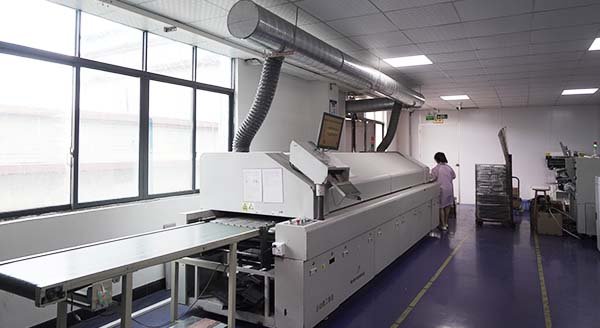
We don't just build generic hardware. Our manufacturing lines are dedicated to engineering the exact tools commercial cultivators need to scale:
- Multi-Channel Intelligent Dimming Systems for flawless transitions between vegetative growth, flowering signals, and pre-harvest finishes.
- High-Penetration Inter-lighting Strips engineered specifically for high-wire greenhouse tomato and cucumber setups.
- Fully Certified B2B Solutions (ETL/DLC) built with premium thermal management to ensure your investment maintains top PPE performance over 50,000+ hours of rigorous operation.
Planning your next greenhouse expansion or vertical farm project?
FAQ
Q1: What is Photosynthetically Active Radiation (PAR)?
A: Photosynthetically Active Radiation (PAR) refers to the specific waveband of light that plants can actually use to drive photosynthesis. Traditionally, this is defined as light within the 380~700nm range, spanning from visible blue to deep red. As a commercial grower, you should focus on PPFD (Photosynthetic Photon Flux Density), which measures how many micromoles (μmol) of PAR photons are hitting a one-square-meter area of your crop canopy every second.
Q2: Can high-intensity photosynthetic lighting damage my plants if used incorrectly?
A: Yes, absolutely. If the PPFD exceeds the plant’s Light Saturation Point, the excess photons can cause photoinhibition and cellular stress, bleaching the leaves or burning the tips. Furthermore, running high-intensity lights without matching the correct environmental parameters - such as ambient temperature, relative humidity, and crucially, CO₂ concentration - will stall growth and waste massive amounts of electricity. For high-PPFD environments (above 800 μmol/㎡·s), supplemental CO₂ is highly recommended to help the plant process the heavy energy load.
Q3: How do I know if my crop requires short-day or long-day photoperiodic signaling?
A: It depends entirely on your crop's genetic classification:
- Short-Day Plants (e.g., Cannabis, Mums, Poinsettias): These crops require a long, uninterrupted dark period (usually 12+ hours) to trigger blooming. Photoperiodic lighting is used here during the vegetative stage to prevent early flowering.
- Long-Day Plants (e.g., Spinach, Clover, some Strawberry cultivars): These crops flower when the night is short. Growers use low-intensity photoperiodic lighting at night to induce early flowering.
- Day-Neutral Plants (e.g., Tomatoes, Cucumbers): These crops are blind to photoperiod signals for flowering. They only care about the total daily volume of light energy, known as the Daily Light Integral (DLI).
Q4: If I use a high-power grow light dimmed down to 2% for photoperiod control, will it flicker or harm the LED lifespan?
A: It won't harm the LED chip lifespan, but it requires a premium-grade, commercial dimming driver. Cheap or low-quality drivers often suffer from pulse-width modulation (PWM) instability at ultra-low percentages (1%~5%), leading to visible or micro-flickering. This flickering can confuse the plant's photoreceptors and ruin the photoperiod effect. At SLTMAKS, our multi-channel fixtures utilize 0-10V or digital PWM isolated smart drivers engineered to deliver smooth, flicker-free, continuous current even at the absolute lowest signal thresholds.