
Introduction:
As supplemental LED lighting becomes standard in high-yield commercial horticulture, buyers are flooded with technical jargon. A prime example is the ongoing confusion between Inter-Canopy Lighting (ICL) and Under-Canopy Lighting (UCL). Many generic trade articles treat them as interchangeable or try to pit them against each other as "better or worse" technologies.
As a dedicated B2B source factory, we believe in engineering reality. These two lighting methods are not competitors; they were designed for completely different application scenarios and botanical architectures. Choosing the wrong style for your facility won't just waste your electricity—it will actively disrupt your cultivation workflow and ruin your ROI. Let's break down the real differences, the crop-specific physics, and the hardware engineering required to make these systems profitable in 2026.
As a dedicated B2B source factory, we believe in engineering reality. These two lighting methods are not competitors; they were designed for completely different application scenarios and botanical architectures. Choosing the wrong style for your facility won't just waste your electricity - it will actively disrupt your cultivation workflow, increase labor overhead, and ruin your ROI. Let's break down the real differences, the crop-specific physics, and the hardware engineering required to make these systems profitable in 2026.
Crop Architecture Determines the Layout: Vining Crops vs. Cannabis
The choice between Inter-canopy and Under-canopy grow light is dictated entirely by how your specific crop grows, its height, and how its foliage density blocks photons.
Inter-Canopy Lighting (ICL): The Choice for High-Wire Vining Crops
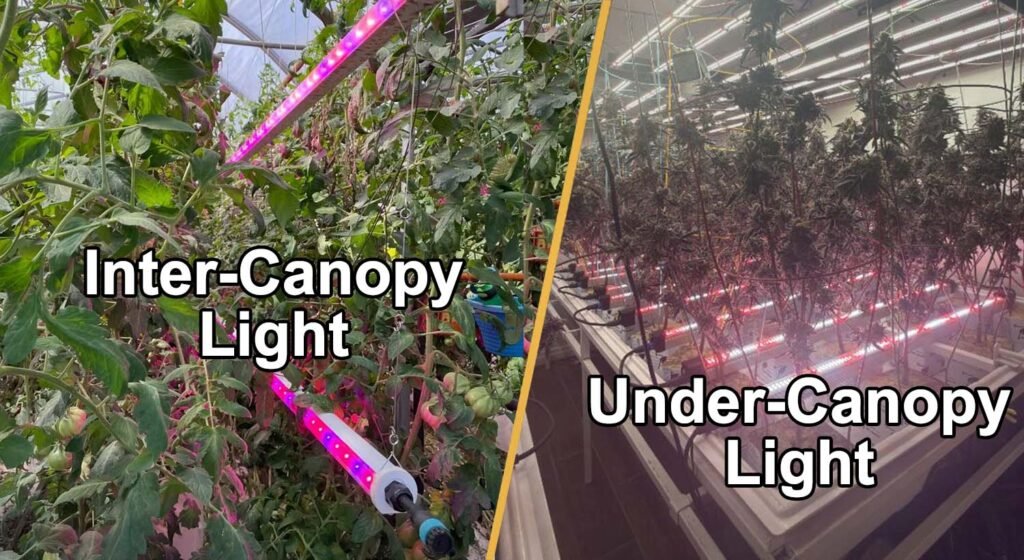
Inter-canopy lighting refers to LED bars hung vertically or horizontally between rows of tall, vining plants.
- Primary Application: Commercial Greenhouse Tomatoes, Cucumbers, and Peppers.
- The Agronomic Reason: High-wire vining crops grow incredibly tall, often reaching 3-4 meters in managed commercial greenhouses, creating a massive vertical wall of vegetation. Even the most powerful overhead greenhouse lights (HPS or high-power LED) cannot penetrate past the top few layers of leaves. This leaves the middle and lower fruit clusters in a permanent "light shadow," delaying ripening and reducing fruit grade. By placing vertical LED bars directly in the row matrix, you ensure that middle leaves maintain high photosynthetic activity, preventing lower-leaf senescence and ensuring even fruit ripening from top to bottom.
Under-Canopy Lighting (UCL): The Game-Changer for Commercial Cannabis
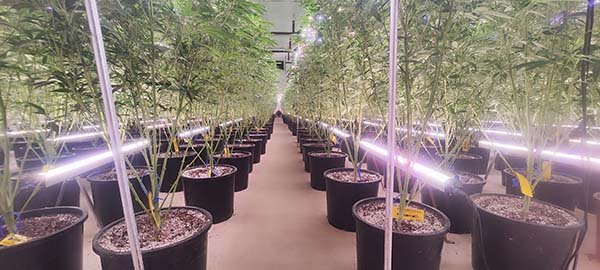
Under-canopy lighting involves placing low-profile LED grow light fixtures horizontally on the ground, on rolling benches, or attached to grow pots, directing photons upward into the plant canopy.
- Primary Application: Commercial Cannabis Cultivation.
- The Agronomic Reason: Cannabis naturally develops a dense, umbrella-like top canopy during the vegetative and early flower stages. Once the flower stage begins, this top canopy acts as an impenetrable shield, completely blocking overhead light from reaching the lower third of the plant. This lack of light results in under-developed, airy, and low-terpene "popcorn buds" that hold very little commercial value and are often discarded as trim. UCL injects high-intensity photons from below, directly targeting those shaded lower nodes. This wakes up the lower flower sites, turning what would have been waste material into premium, dense A- and B-grade buds, increasing total scalable yield by 20% - 35%.
The Deep Dive into Under-Canopy Physics: Spongy Tissue Acceptance and the Diminishing Returns of Overhead Lights
When designing an under-canopy system for a commercial facility, professional B2B engineering must respect a rigid law of plant anatomy that cheap consumer brands completely ignore: Leaf Underside Asymmetry and Photonic Economic Efficiency.
The Anatomy of the Leaf Underside: Spongy Tissue Reality
Skeptics often ask a valid question: "Does lighting a leaf from the bottom work as efficiently as from the top?" The biological answer is no, but the commercial ROI answer is a resounding yes.
A leaf's top surface consists of packed palisade tissue, which evolved with tightly clustered chloroplasts designed to absorb direct, intense overhead sunlight. The underside consists of loose, cavernous spongy tissue, designed primarily for gas exchange via stomata. Because of this non-symmetrical internal structure, when photons hit the leaf underside from a under canopy led grow light fixture, the photon absorption and photosynthetic utilization efficiency is about 20% - 40% lower than the top surface.
The Law of Diminishing Returns: Why Adding Top Power Fails
If the underside is less efficient, why not just buy a stronger 1000w overhead grow light instead of a 120w under canopy led grow light? This is where the Light Saturation Point comes into play.
The top leaves of your crop under a standard 800w commercial LED are already pushing past their maximum capacity to process photons. Once a leaf hits its light saturation point, adding more PPFD from above delivers diminishing returns. The plant cannot photosynthesize any faster; instead, the excess energy turns into heat stress, causing the stomata to close, which stalls growth and wastes expensive electricity.
Conversely, the lower third of the plant is starved, sitting entirely below its Light Compensation Point (the minimum light needed to survive, let alone produce flowers). Injecting 150w of targeted photons from the bottom means that even with the 30% anatomical absorption penalty, you are taking a dormant, zero-productivity zone and forcing it to photosynthesize at 60% - 70% capacity. You are unlocking trapped genetic potential without increasing top heat or overloading your HVAC system.
The 2026 Under-Canopy Hardware Standard: Pure Aluminum vs. Plastic-Clad Cooking
Because Under-Canopy lighting operates in the most punishing microclimate of the entire facility - directly above damp soil, under high ambient humidity, and amidst intense localized diode heat - hardware durability is where genuine B2B factories clear the field of cheap trading companies.
The Real Physics of Pure Aluminum vs. Plastic-Clad Aluminum
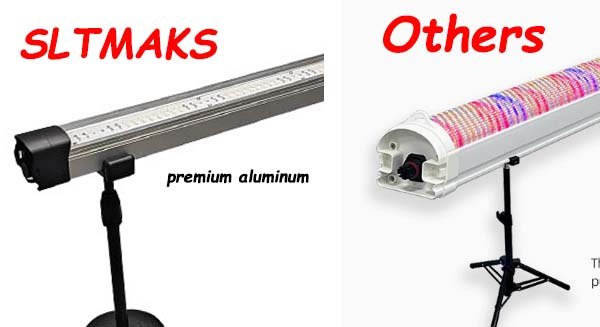
To achieve low price points, competitors use Plastic-Clad Aluminum housings. Plastic has an abysmal thermal conductivity rating of less than 0.5 W/m·K. It acts as an insulative blanket, trapping the heavy heat generated by the high-efficiency diodes (especially 660nm deep red chips) inside the core. The internal chip junctions are baking at very high temperature. This cooks the phosphor and causes immediate, permanent PPFD degradation.
Our factory strictly utilizes heavy-gauge aircraft-grade aluminum (200 W/m·K) . Our heavy aluminum profile acts as a rapid thermal highway, pulling heat away from premium Samsung chips and instantly radiating it to the outside environment. Yes, our bar will feel hot to your hand - because it is successfully transferring destructive heat away from the chips. This engineering safeguards your spectrum stability and guarantees a 50,000-hour operational lifespan.
Environmental Protection: Corrosion and Moisture Mitigation
The under-canopy environment is the primary splash and runoff zone during daily watering, foliar feeding, and pest-control spraying. A standard light fixture will fail under these chemical-heavy, wet conditions. Our under canopy grow lights are engineered with IP65 certified dust and moisture seals, and our pro model is with glass cover. This prevents the acidic or alkaline chemical nutrients used in commercial cultivation from oxidizing the metal or penetrating the electronics, ensuring total safety and structural integrity over years of continuous wet-room operation.
Conclusion:
In the high-stakes world of commercial cultivation, every square meter of canopy must be optimized for maximum profitability. Inter-canopy and Under-canopy lighting are sophisticated tools that require precise matching with your crop type and facility infrastructure.
If you are running a high-wire tomato greenhouse, invest in commercial inter canopy grow light. If you are operating a state-of-the-art cannabis facility looking to eliminate popcorn buds and boost top-tier flower weight, industrial-grade under canopy led grow light is your definitive solution.
FAQ
Q1: How do you physically install and fix undercanopy lights in a commercial facility? Do they interfere with rolling benches or pots?
A: Our under canopy led grow lights are engineered for maximum operational flexibility and zero interference with your existing facility infrastructure. We offer three flexible mounting options depending on your setup: Using stands or just place it on your coco/rockwool pots.
Q2: How much Under-Canopy PPFD is considered optimal for cannabis flowering, and will it cause light burn if the leaves touch the fixture?
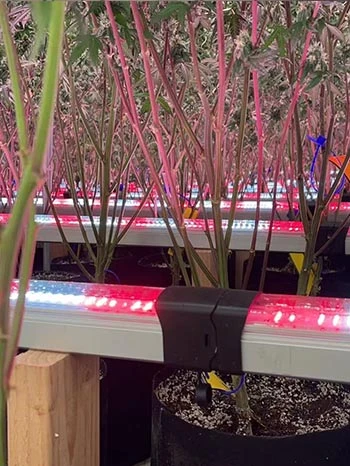
- A: In commercial cannabis facilities, the industry target is to inject an additional 200 - 350 μmol/㎡/s of PPFD directly into the lower third of the canopy. This intensity is high enough to drive aggressive floral swelling without triggering metabolic shock.
- Regarding light burn: Because our UCL fixtures utilize a wide-angle linear beam distribution and distribute the total wattage across a long, premium aluminum body, there are no dangerous localized "hot spots" common in high-power overhead fixtures. If the lower fan leaves physically touch the optical cover, they might experience minor thermal singeing over time due to the aluminum's heat-evacuation process, but it will not cause widespread photonic light burn or bleaching. We recommend a minimum clearance of 5-10cm (2 to 4 inches) between the light bar and the stalk bases for perfect light distribution. In reality application, the cannabis is high, and the leaves can not touch the light.
Q3: How many undercanopy grow lights can I daisy-chain together on a single power circuit? What is the maximum run length?
A: The maximum number of fixtures per circuit depends on your facility's operating voltage (120V 220W or 240V) and the wattage of the specific under canopy light model.
120W - 4Ft
Under Canopy Grow Lights
| Voltage | Amps | Daisy-chain Qty. |
| 120V | 1A | 12pcs |
| 220V | 0.55A | 21pcs |
| 240V | 0.50A | 24pcs |
| 277V | 0.43A | 27pcs |
240W - 8Ft
Under Canopy Grow Lights
| Voltage | Amps | Daisy-chain Qty. |
| 120V | 2A | 6pcs |
| 220V | 1.1A | 10pcs |
| 240V | 1A | 12pcs |
| 277V | 0.86A | 13pcs |