
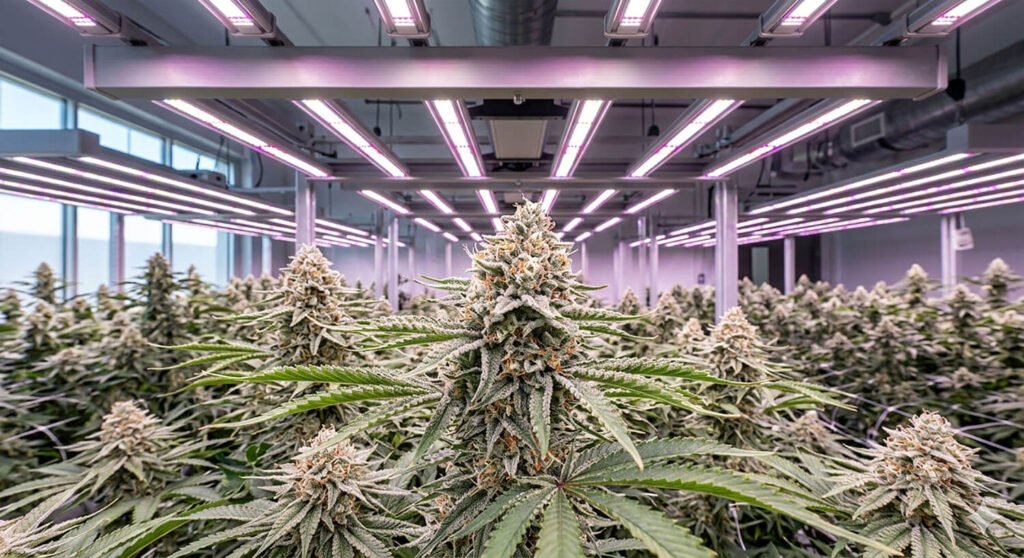
Beyond Potency: Boosting Trichomes and THC with UV-A & Far-Red
In the saturated cannabis market of 2026, cultivation success is no longer a simple race for maximum weight. While many operations chase sheer volume (yield per square foot), the leading commercial cultivators have recognized that the true battleground is Premium Quality (Top-shelf/Exotic) and the secondary metabolites - the chemical profile (THC, CBD, Terpenes) - that define it.
A hard truth dominates the current market landscape: Total Revenue = (Yield) × (Price per Gram). In 2026, due to strict intra-state trade regulations limiting cross-state movement, your reputation in your local market hinges entirely on product differentiation. A flower that looks average and tests at 20% THC (often the outcome of chasing volume) competes in a flooded market, frequently commanding low prices (around $500/lb during current lows). However, a meticulously grown flower, characterized by extraordinary bag appeal (tight structure, vibrant color) and a dense crystalline coating (often achieving an additional 1% THC/potency), can command a premium price (up to $1,000/lb even during market lows, and $2,000/lb in specific zones and peaks).
This difference of 1% THC and superior bag appeal isn't accidental; it's a matter of biological precision, and Light is your most powerful tool.
1: Light Quality as the Primary Signal for Cannabinoid Synthesis
For the Quality-Centric cultivator, light is not merely a fuel for photosynthesis; it is a regulatory signal (photomorphogenesis). The unique profile of wavelengths your light fixture emits determines which defensive mechanisms the plant activates. The resin you seek (the "frosty" look) is essentially the plant's shield against environmental stress.
1.1 The Crucial Role of UV-A (395nm)
Many cultivators chase volume using generic high-PPFD fixtures, often overlooking the targeted signals that drive potency. We utilize targeted UV-A radiation (395nm) for a specific biological response.
- Biological Mechanism: Research, notably from Dr. Bruce Bugbee (Utah State University), indicates that plants perceive UV-A as a stressor, inducing a protective "sunscreen" response. This triggers the production of secondary metabolites, specifically increasing trichome density and cannabinoid concentration.
- Commercial Impact: Implementing controlled UV-A doses during late-flower not only enhances the visual "frosty" appeal (bag appeal) but also provides the necessary metabolic signal to help you breach that 2% vs. 3% THC barrier. This is the difference between average volume and premium, high-value product.
1.2 Red (660nm) and Far-Red (730nm): The Master Controllers of Flower Structure and Cycle Efficiency
Achieving the necessary tight flower structure (Density) that premium buyers demand requires masterful control over the Red to Far-Red ratio (R:FR).
- 660nm Deep Red for Bulk: This wavelength provides the maximum quantum yield for photosynthesis, driving the bulk weight.
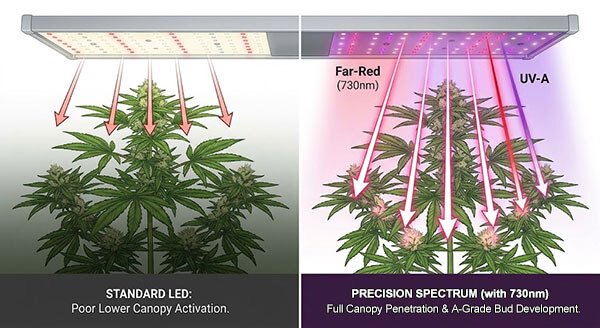
- 730nm Far-Red for Control and "Sleep" Induction: When applied with precision, Far-Red can induce the Shade Avoidance Response, enhancing canopy penetration and maximizing light absorption on the lower buds (increasing your 'A-grade' ratio).
- Biological Mechanism - "The Sleep Trigger": Far-Red light at the end of the light period rapidly converts phytochrome from its active form (Pfr) to the inactive form (Pr). In nature, this takes two hours; a 15-minute Far-Red pulse at sunset can achieve this in minutes. This effectively shortens the plant’s perception of the night, potentially allowing you to shave 5-7 days off your total flowering cycle. This optimization directly translates to more harvest turns per year, maximizing the ROI of your facility.
2: Thermal Management and the Preservation of Terpenes
Your light spectrum is only as good as your thermal management. You cannot achieve premium pricing without a robust, aromatic terpene profile.
2.1 The Volatility Trap
Terpenes, such as Myrcene and Limonene, are volatile organic compounds that begin degrading well below optimal leaf temperature, starting around 30°C (86°F) according to research published in Frontiers in Plant Science (2024). Many generic, high-wattage LEDs generate excessive, localized radiant heat on the canopy, effectively boiling away your flavor and profit.
2.2 Cold Operation = Premium Nose
A fixture's physical structure is critical. SLTMAKS grow light uses advanced passive cooling (heavy-duty aluminum heatsinks) that keeps radiant heat minimal. By maintaining the canopy microenvironment at an ideal VPD (Vapor Pressure Deficit), we ensure the plant’s stomata remain open for efficient CO2 exchange without causing heat stress that volatizes the aromatic hydrocarbons. If your flowers smell weak, your price per pound drops.
3: The 2026 Commercial Reality—ROI via Differentiation
Let’s look at the financial reality of the 2026 market (based on active trading data):
3.1 2026 Profitability Model: Premium Differentiation
| Cultivation Strategy | Key Biological Target | 2026 Low Market Price (Per lb) | Peak-Market Price (Per lb) | Commercial Outcome |
| Yield-Centric (Generic Light) | Maximum 2% THC | $500 | $1,000 | Survival mode/ High volume |
| Quality-Centric (Precision Spectrum) | Targetted signals (SLTMAKS) 3% THC, High Density/Big Bud | $1,000 | $2,000 | High-value differentiation |
In a difficult intra-state market, the $500 price point often barely covers operating costs (labor and electricity). The Quality-Centric cultivator using precision signals to secure the $1,000/lb price point (even at the low end) is building a sustainable, profitable business.
3.2 Long-Term Asset Stability
Premium buyers demand consistency. While initial fixture cost is a factor, the degradation rate (L80) of top-bin chips (Samsung/Osram meeting LM-80 standards) ensures that your product quality remains consistent over 5+ years. Relying on generic chips that degrade 5-10% annually erodes your brand reputation and market share.
4: Technical and Commercial Deep Dive (FAQ)
Q1: How do I manage the UV-A and Far-Red signals without manually adjusting my lighting?
- Answer: We recommend integrating our smart control system (supporting industrial protocols like 0-10V, PWM, or Mesh). This allows you to pre-program specific spectral 'recipes' for the vegetative, pre-flower, and late-flower phases, maximizing metabolic induction without human error.
Q2: Will the 1000W fixture increase my HVAC load compared to standard lights?
- Answer: No. LED fixtures have a much higher electricity-to-light conversion efficiency (efficacy, PPE) than legacy HPS. Because SLTMAKS uses advanced passive cooling and a split-driver design, you generate less radiant heat per square foot of plant canopy, allowing you to manage your environmental VPD (Vapor Pressure Deficit) with greater precision, which often reduces total HVAC stress.
Q3: How close can I hang the lights for vertical farming (Vertical Farming)?
- Answer: Our fixtures are ultra-thin and distribute light exceptionally uniformly. For multi-tier setups, we recommend hanging the lights between 6 and 12 inches above the canopy. This uniform coverage allows you to maximize your vertical space utilization without the risk of hot spots and light burn, ensuring consistency across every layer of your farm.
Q4: Why do you prioritize 395nm over the cheaper 405nm purple diodes?
- Answer: This is a critical technical distinction. 395nm is true UV-A, which triggers the biological stress response necessary for cannabinoid synthesis. 405nm is essentially visible violet light; it may look purple to the eye, but it lacks the energy to activate the protective resin mechanisms you need for premium pricing.
Q5: Are your fixtures DLC-certified, and what is the financial benefit for me?
- Answer: Yes. DLC certification is the gold standard for reliability. In the US, it is also the primary requirement for Utility Rebates. Depending on your state, you could receive 30% to 50% of your fixture cost back from your power company, drastically shortening your initial payback period.
Q6: In the 2026 low-market, should I focus on 'Total Yield' or 'THC Density'?
- Answer: Total yield gets you through the door, but THC density (potency) gets you the premium price. When the market average is low, your survival depends on differentiation. Utilizing precision spectrum signals to help you hit that extra 1% THC and dense bag appeal is the single most effective way to secure a stable, higher-margin revenue stream.
Q7: How can I prove the value of these lights to my wholesale buyers?
- Answer: We encourage "side-by-side" testing. When your buyers see the increased Bag Appeal - the tighter bud structure and the "frosty" crystalline coating (trichomes) - the difference is visible to the naked eye even before lab testing confirms the higher potency.
Q8: Do these specific spectrums help with pest or mold management?
- Answer: Targeted UV-A and high-intensity Blue light have been shown to inhibit the growth of certain pathogens, such as powdery mildew. While not a replacement for IPM, it adds a layer of environmental protection that helps ensure your harvest passes strict state testing.
Q9: Can you provide Spectral reports for my own brand (OEM/ODM)?
- Answer: Absolutely. As a factory with 130+ patents, we provide full technical documentation, including PPFD and integrating sphere reports. This allows you to prove to your partners that your brand is backed by rigorous, fact-based engineering.
Conclusion
In the competitive landscape of commercial cannabis in 2026, light is no longer an afterthought. Precision spectrum lighting is the mechanism that translates biological potential into measurable financial value (ROI).
Don’t settle for generic illumination. Contact our technical team today to discuss how we can engineer a custom light recipe, utilizing targeted UV-A and Far-Red signals, to help your cultivars achieve their maximum potency and secure your operation’s position in the premium market.
References & Scientific Attribution
- B Bugbee. The Science and Technology of Medical Cannabis Cultivation 4th Edition. Utah State University. (This unique university-level online courseabout how to optimize yield and quality in medical Cannabis).
- American Society of Agricultural and Biological Engineers (ASABE). ANSI/ASABE S640: Quantities and Units of Electromagnetic Radiation for Plants. (The international standard for measuring PAR and spectral distribution in commercial horticulture).
- Cannabis Science and Technology. Understanding VPD and Transpiration Rates for Cannabis Cultivation Operations. (Research explores how vapor pressure differentials (VPD) affect transpiration rates in cannabis plants.).
- DesignLights Consortium (DLC). DesignLights Consortium Seeks Input on the Next Version of its Horticultural Lighting Technical Requirements. (The industry benchmark for LED lifespan and rebate eligibility).
- Market Analysis Report (2026). Regional Pricing Volatility and Quality Premiums in Intra-state Cannabis Trade. (Internal industry data regarding the $500 vs. $1,000/lb price bifurcation).
- Frontiers Elevated UV photon fluxes minimally affected cannabinoid concentration in a high-CBD cultivar Utah State University, Department of Plant Sciences. (The foundational study on how UV-A triggers protective resin/THC synthesis).
- Bruce Bugbee: Photons from NIR LEDs can delay flowering in short-day sybean and Cannabis: Implications for phytochrome activity